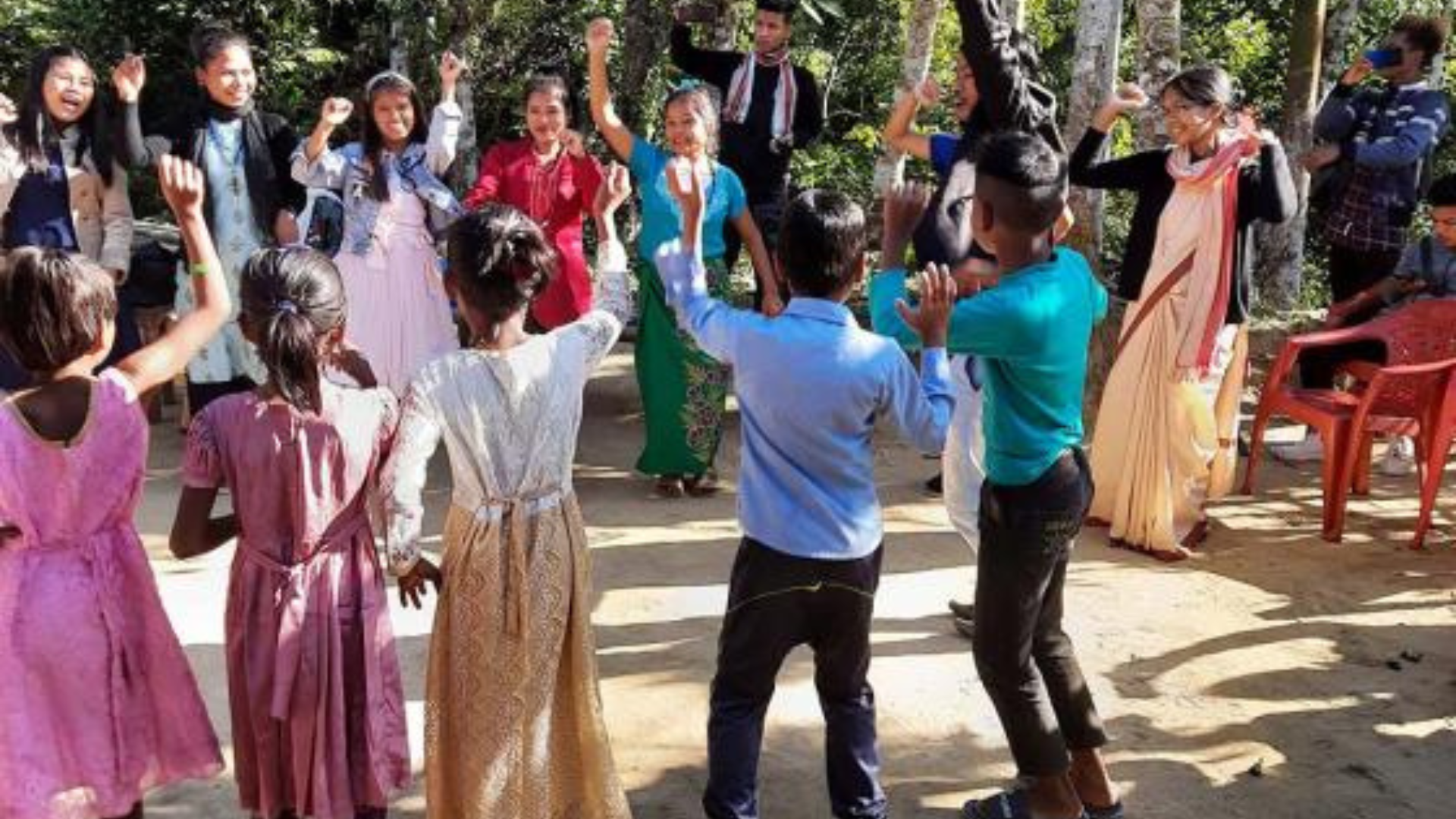
Traditional group dances, usually performed during harvest festivals or weddings, are adapted for Christmas (Photo: Global Sisters Report)
In many tribal regions of India, Christmas is observed away from formal church buildings. Instead, communities gather in forest clearings, on hill slopes, or near village commons surrounded by trees. These gatherings, often referred to locally as forest church celebrations, reflect how Christian faith has taken root alongside long-standing indigenous traditions.
Across states such as Jharkhand, Chhattisgarh, Odisha, parts of the northeast and pockets of central India, Christianity arrived through missionaries during the colonial period. While church structures were later built in many areas, some villages continued older tribal practices of meeting outdoors. Limited access to buildings, dispersed settlements and a close relationship with land shaped these choices. Over time, open-air Christmas gatherings became a regular practice rather than an exception.
On Christmas Eve or Christmas morning, families walk to a common forest space chosen by village elders or church leaders. Temporary arrangements are made using bamboo, cloth and wooden benches. A simple cross, often made from local wood, is placed at the centre. There is no permanent altar. Hymns are sung in local languages rather than Latin or English. Drums, flutes and traditional instruments accompany the singing in some regions.
Also Read:Celebrate in style: Unmissable Christmas markets in India

Food plays a central role during Christmas
The service usually follows a basic Christian structure. Passages from the Bible are read, prayers are offered and a sermon is delivered by a pastor, catechist, or senior community member. The message often connects biblical stories with daily life, farming cycles, or collective responsibility. References to forests, land and seasons are common, reflecting the audience’s lived experience.
In many villages, Christmas celebrations extend beyond a single service. Preparations begin days in advance. Houses are cleaned, courtyards are decorated with leaves, flowers and hand-drawn patterns made with rice paste or coloured soil. Instead of store-bought decorations, people use forest produce such as branches, seeds and handmade paper stars. Some communities place oil lamps along paths leading to the gathering site.
Food plays a central role. After prayers, families contribute dishes prepared at home. Rice, millets, seasonal vegetables, forest greens, meat, chicken and locally brewed drinks are shared. There is no formal seating arrangement. People eat together on the ground or on long wooden planks. Elders, children and visitors share the same space, reinforcing social ties.
Music and dance often follow the meal. Traditional group dances, usually performed during harvest festivals or weddings, are adapted for Christmas. Lyrics may refer to the birth of Jesus but follow local rhythms and movement patterns. In some areas, youth groups perform short plays narrating biblical stories in a village setting, replacing Middle Eastern imagery with local references.
These celebrations reflect how tribal communities interpret Christianity through their own cultural framework. For many, faith is not separated from land or daily work. Forests are seen as shared spaces rather than resources to be enclosed. Holding Christmas gatherings outdoors emphasises this connection. Elders often explain that worship under open skies feels closer to their understanding of community life.
Also Read:New ways to celebrate Christmas at Metropole Monte-Carlo
Church leaders working in these regions acknowledge this approach. Many local pastors are from the same communities and see no conflict between Christian belief and indigenous practices. They says that faith was accepted because it did not demand a complete break from existing customs. Instead, it was woven into them.
However, these traditions face challenges. Younger generations increasingly migrate to towns for education and work. Exposure to urban church practices, including decorated buildings, choirs and formal services, influences expectations. Some youth prefer celebrating Christmas in churches with lighting, sound systems and organised events. As a result, attendance at forest gatherings has declined in certain villages.
Land use changes also affect these practices. Deforestation, mining and infrastructure projects have reduced access to forest spaces. In some areas, gatherings have shifted from deep forest locations to village grounds due to safety concerns or legal restrictions.
Community leaders note that the loss of forest land affects not only livelihoods but also cultural and religious life and despite these pressures, many villages continue the practice deliberately. Elders see it as a way to pass on both faith and cultural memory.