
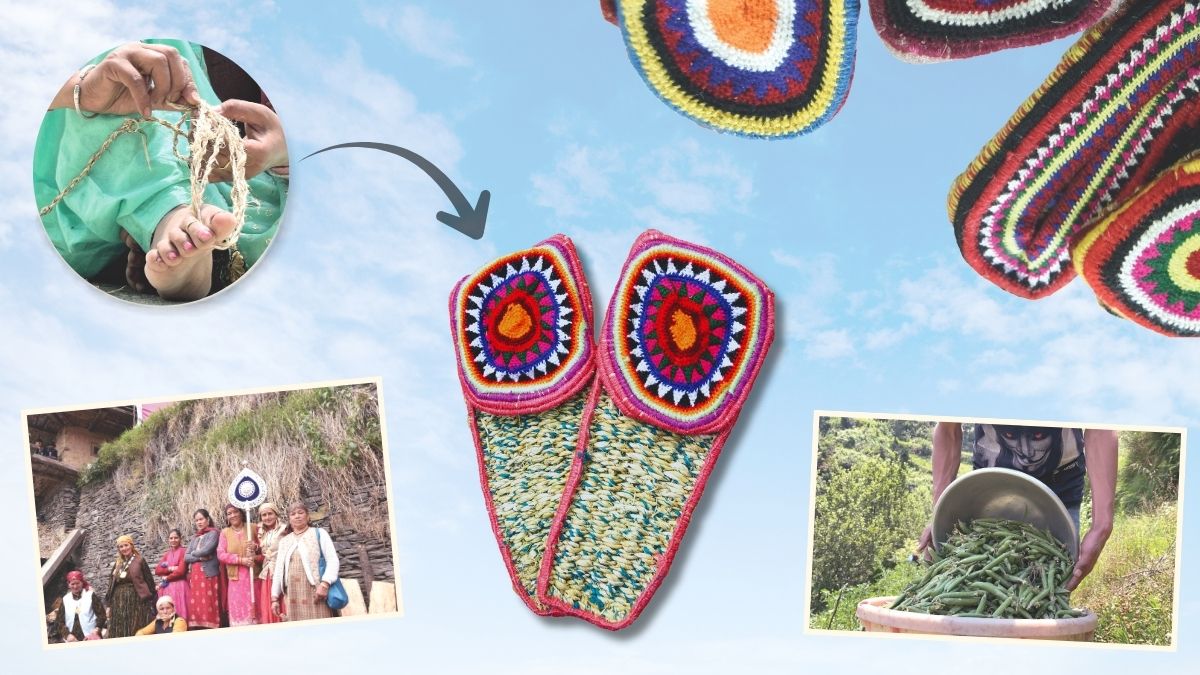
Local women create pullas, colourful handmade slippers that carry stories of resilience, creativity and community (Photos: India & You)
Like many other villages in the Himalayas, Naihra and its neighbouring hamlets have all that most other parts of India are today sorely missing, peace and quiet, a slower pace of life, untouched natural beauty and a quietly thriving craft tradition. Here, in sunlit courtyards surrounded by apple orchards and pine-covered slopes, local women create pullas, colourful handmade slippers that carry stories of resilience, creativity and community.
For someone visiting Naihra, which is easily accessible by bus from Shimla, capital of Himachal Pradesh, the experience is far from what you would find in a popular hill station in peak summer. Instead of a long queue of impatiently-honking cars, there is peace and calm and hardly a vehicle in sight. In place of all the hills crammed with hotels and restaurants, removing all signs of being in the mountains, at Naihra, there is just an immense sprawl of nature. Everywhere you look, shades of green unfold, from terraced fields of peas and potatoes to berry bushes dotting the roadside trails. Cows, goats and sheep graze freely on the hillsides, bringing life and gentle energy to the quiet, rolling hills.
Also Read: Offbeat destinations to explore in Himachal Pradesh
Life in Naihra moves slowly and the air here is cool and crisp. The village itself is small, with only a few homestays, a conscious decision by locals who want to preserve the region’s natural charm. These stays are simple but warm, run by families who welcome you with stories, traditional food and endless cups of tea.
If one is lucky, one might even get invited into a home. Children run around as one chats with the hosts, watching them prepare siddu, a steamed local delicacy, or dham, a festive platter with lentils, rice and curd-based curries served on special occasions. After a simple but delicious meal, one can head for a short walk through narrow trails leading to hidden waterfalls or to hilltops offering panoramic views of the valley. You may stumble upon ancient wooden temples adorned with carvings in traditional Himachali style, or find yourself helping with pea harvesting on a nearby farm. Every moment here feels rooted in a rhythm, of nature, of people, of the land.
Pull of pullas
While strolling around the village, one also sees the villagers busy crafting pullas that have traditionally been made of natural materials, notably the fibres of hemp, a naturally-occurring plant in this part of the Himalayas.
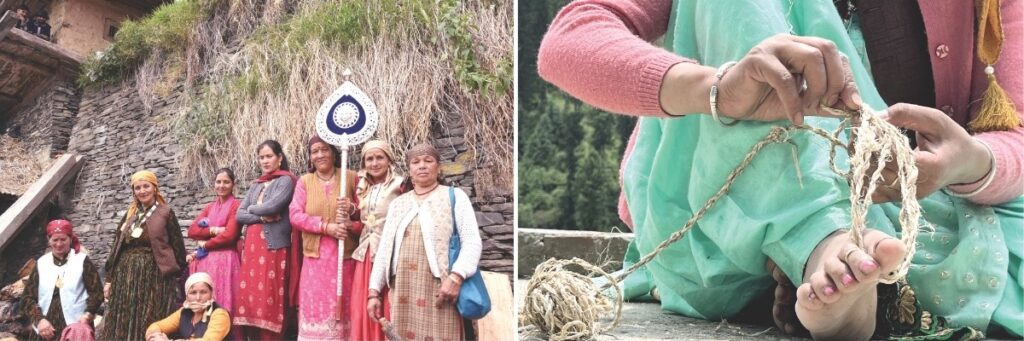
Local women in Naihra keep the region’s traditional craft alive
Meant to be worn indoors, these chappals are unique in appearance and purpose. Their thick soles are braided from hemp fibre, traditionally sourced from the wild cannabis plant. The soles offer a firm grip and a pleasant, bouncy feel underfoot, like a light massage with every step, making them both comfortable and fun to wear around the house.
What makes pullas instantly recognisable is their upper design. Triangular motifs stitched in a radial pattern form a vivid, colourful top. Each pair showcases nine bright hues like reds, greens, purples, neon pinks, electric blues and fluorescent accents, earning them the name naurangi pullas, or nine-coloured pullas. Locals say these colours help lift spirits during the long grey winter months when the hills are snow-covered and everything feels muted.
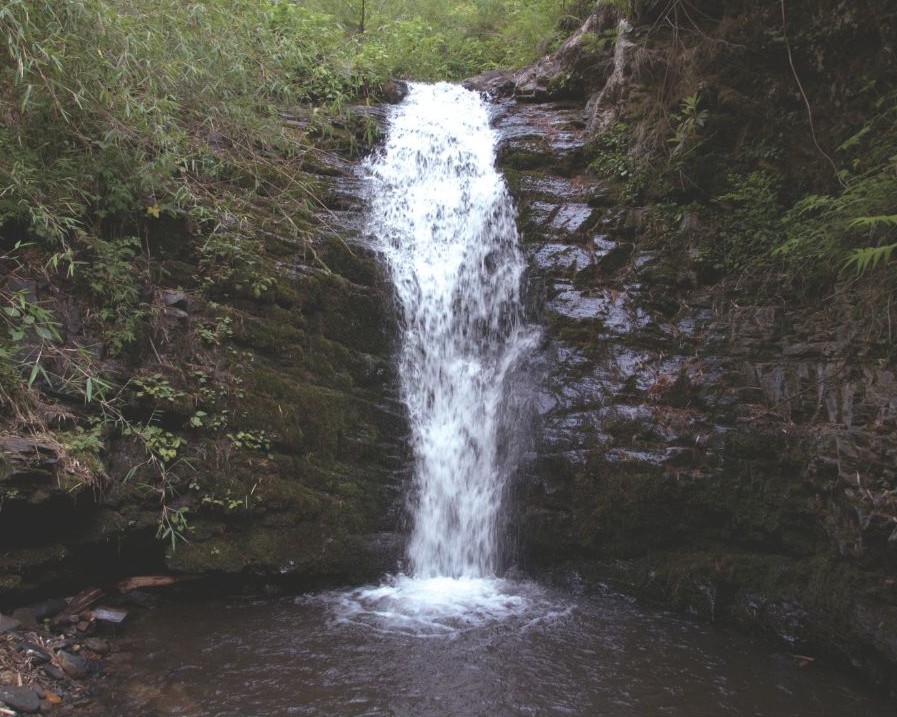
A quiet waterfall tucked away in the lush hills around Naihra, offering a peaceful escape into nature
The tradition, now over 150-year-old, has been passed down through generations of women in the region. While men focussed on farming or travelled to the plains for work during the colder months, the women stayed behind and gathered together to spin yarn, braid soles and stitch colourful motifs. The process was once done using goat hair and coarse wool, but over time, softer wool and now acrylic yarns became the norm. These newer materials brought ease and vibrancy but also began to shift the original look and feel of the chappals.
As in many other villages in this part of the Himalayas, winters in Naihra are long and unforgiving. The biting cold often keeps women indoors for weeks. In these quieter months, pulla-making becomes a source of comfort and continuity, a way to connect with one another, stay productive and earn a little while keeping the tradition alive.
Also Read: Barot Valley: Himachal Pradesh’s untouched paradise
Yet, like many other traditional crafts across India, pullas, too, are facing rising existential challenges. Younger generations are no longer drawn to the intricate process of weaving and stitching and many parents, too, want their children to focus on studies and jobs that offer more stable returns. Moreover, curbs on regulations on hemp cultivation have made the original raw materials harder to access and the artisans are forced to use plastic cords, jute, or synthetic fibres, which compromise the quality, both in function and feel.
Also Read: From Misty Trails to Woven Tales: Discovering Naihra’s Pullas
Despite these challenges, pullas continue to hold deep cultural significance. Women wear them during pregnancy and postpartum periods. Some locals even believe they offer healing properties, especially for body aches and joint pain. In temples, pullas are worn by Dhamis, spiritual practitioners who prepare and serve prasad. The slippers are also part of Dashadaan, a traditional ritual where 10 symbolic items are donated during special occasions. During weddings, they are gifted to the bride and groom as blessings for a comfortable and healthy life.
“I travel across six or seven gram panchayats and collect around 30-50 pairs at a time from nearly 400 women. I supply them to Manali, Kullu, Shimla, Hamirpur, and sometimes even to Khadi Emporium outlets. Earlier, I used to pay just INR 10 per pair. Now I pay between INR 80-100. But the profit margins are very low and I make only INR 20-30 per pair. Demand has dropped, supply too, and the quality is not the same anymore. The materials have changed and that has changed everything,” Shyam Lal, a 67-year-old trader who has worked with pulla artisans for decades, tells India & You.
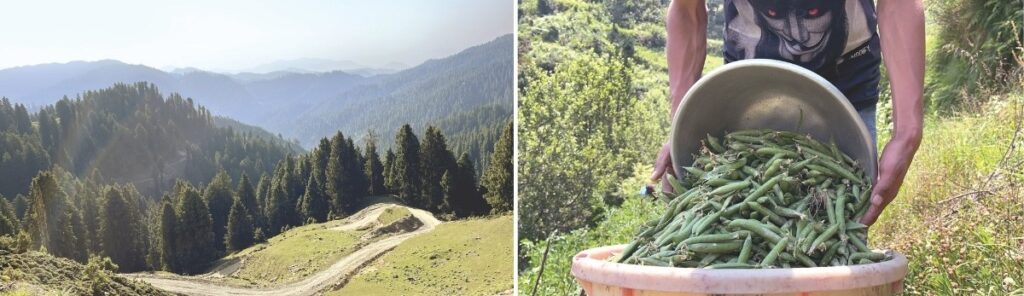
The lush hills of Naihra, where terraced fields and fresh pea harvests are part of everyday village life
Pullas are rarely seen in large urban markets. They appear mostly during fairs, religious events, or special village celebrations. Occasionally, they surface in places like Delhi, Jaipur, or Punjab, brought there by curious travellers or independent sellers.
Also Read: Chitkul: Last inhabited village of Himachal Pradesh
The making of a pulla is slow and intentional. It can take up to two or three days to complete just one single pair. Artisans work with skill passed down through generations, following the rhythm of memory and observation rather than written instructions. They sit cross-legged on verandas, hands moving with quiet precision as children play nearby and old folk songs drift in from a neighbour’s radio. There is a rhythm to the work, part tradition, part meditation.
In many ways, Naihra’s charm mirrors the nature of the pullas themselves, understated yet memorable, full of colour but rooted in simplicity. The landscape may be humble, but it holds immense depth. From the scent of damp soil in the morning to the sight of clouds brushing through hilltops, every detail feels like part of a bigger story.
