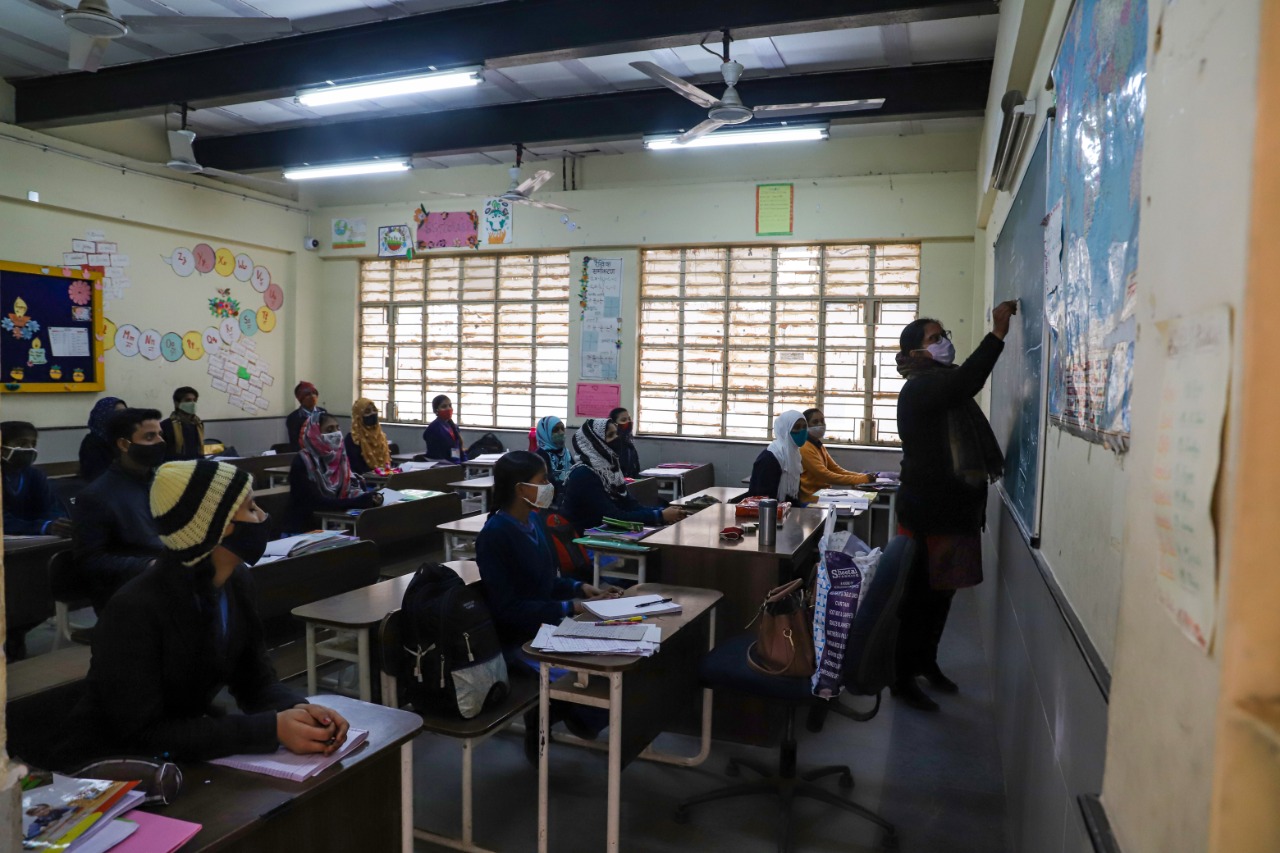
Thousands of schools have closed or merged over the past decade, with nearly one school disappearing every day (Photo: Media India Group)
Even as the Union government claims overall improvement in the education system in India, highlighting the National Education Policy (NEP) 2020, and claiming increased budgetary allocations and improvements in learning outcomes, its own school database shows that enrollment has continued to decline, particularly at the primary level. The contrast has become sharper because these declines are occurring even as the population, including those of children in the school-going age continues to increase year after year.
More than 93,000 schools have disappeared over the past decade through closures and mergers, averaging about one school closing every day, raising uncomfortable questions about where the millions of children studying in those and other schools, have gone and whether access to education is becoming more difficult in rural India, leaving its youngest learners behind.
The debate has gained renewed significance after the Ministry of Education’s Unified District Information System for Education Plus (UDISE+) 2024-25 report which revealed the sharpest decline in school enrollment in recent years, even as the government continues to describe education as a key pillar of its high-profile Viksit Bharat 2047 vision, an initiative aimed at transforming India into a developed nation by the centenary of Independence through improvements in education, healthcare, infrastructure, employment and economic growth.
Also Read: 46 million children out of school as India’s education spending stays below 6 pc target: UNESCO
Mystery of missing schools and children
India officially became the world’s most populous country in 2023 and the United Nations estimates its population reached about 1.46 billion in 2025. While overall population continues to grow, government data shows school enrollment is moving in the opposite direction.
The government’s own UDISE+ 2024-25, the country’s official school database, shows that total enrollment from Classes 1 to 12 has declined to 232.9 million in 2024-25 from 255.7 million in 2021-22, representing a fall of 16 million students (6.4 pc) and the lowest enrollment recorded since 2017-18.
The decline is even sharper at the elementary level, where the foundations of India’s education system are laid. According to UDISE+ 2024-25, enrollment in Classes 1 to 5 has fallen to 104.4 million, down by 346,000 students in just one year and by 17.5 million students (14.33 pc) since the 2021-22 peak.
The decline had already begun appearing in the previous year’s report. UDISE+ 2023-24 showed total school enrollment declining to 248 million from 251.8 million in 2022-23.
The Ministry of Education claimed that part of the decline was due to improvements in data collection after shifting to Aadhaar-linked individual student records, saying duplicate and ghost enrollments were removed from the database.
However, education experts argue that the explanation does not fully account for the continued decline.
Anil Bansal, an educationist at Udemy, an online learning platform based in Gurugram, says that improvements in data collection may explain part of the decline, but they do not account for the consistent fall in enrolment over successive years.
He says the trend reflects a combination of demographic shifts, changing parental preferences and structural changes within the school education system.
“Data cleansing certainly improves the accuracy of enrollment records, but when primary enrollment continues declining across multiple academic years, it points towards broader systemic changes. India is witnessing lower birth rates, increasing migration and a steady movement of families towards private schools. These factors together are reshaping the composition of school education, and policy responses need to recognise this changing reality rather than viewing it as an isolated statistical trend,” Bansal tells Media India Group.
According to education researcher Professor Arun C Mehta, whose analysis is based on official UDISE+ data, the Net Enrollment Ratio (NER) at the primary level dropped from 92.7 pc in 2020-21 to 79 pc in 2023-24, indicating that the decline extends beyond statistical corrections.
The impact has been particularly severe in some of India’s largest states. Based on official UDISE+ data, Uttar Pradesh recorded a decline of 2.826 million students in a single year between 2022-23 and 2023-24, while Maharashtra lost 1.86 million students during the same period.
The enrollment decline has been accompanied by a steady reduction in the number of schools.
The impact of school mergers is already being felt in several villages across Uttar Pradesh, where families say children now spend considerably more time travelling to school than before.
Also Read:As Pradhan resigns, students say battle for education has just begun
Sunita Devi, a resident of the village of Chakri Kheda in Kakori tehsil, near Lucknow, says her son had been attending the government primary school in the village before it was merged with another school several kilometres away.
“Earlier, my son could walk to school in less than 10 minutes. After the school was merged, he has to travel much farther every day. During the rainy season, the roads become difficult and I worry about sending him alone. Sometimes he misses school because arranging transport is not always possible,” Sunita tells Media India Group.
Her son, Shivam Singh, a Class 4 student, says the longer journey has made attending school more difficult.
“I leave home much earlier now. By the time I reach school, I am already tired. I miss my old school because it was close to home and all my friends were there,” he says.
According to a written reply by Minister of State for Education Jayant Chaudhary in the Lok Sabha, India had 1.107 million schools in 2014-15. By 2024-25, the number had declined to 1.013 million, meaning over 93,000 schools have disappeared over the past decade, equivalent to around 30 schools every day.
Another Ministry of Education reply in Parliament shows that government schools alone declined from 10,32,570 in 2019 to 10,17,660 in 2024, representing a reduction of 14,910 schools.
The largest decline was reported in Madhya Pradesh, where 6,972 government schools disappeared, followed by Odisha (4,589) and Jammu & Kashmir (4,380).
Even more striking is the fact that according to the Ministry’s own parliamentary data, 65,054 government schools now have fewer than 10 students or no students at all, while still employing 1,44,238 teachers. West Bengal accounts for the largest number of such schools, with 6,703.
The government insists these are not closures in the conventional sense.
In Parliament, the Ministry said that many schools have been merged because of declining enrollment, rural-to-urban migration and rationalisation of resources, arguing that consolidating nearby schools improves infrastructure and teaching quality.
Official figures show nearly 35,000 schools have been merged in Madhya Pradesh, over 4,300 in Jharkhand and around 2,000 in Odisha, while states including Uttar Pradesh, Karnataka, Himachal Pradesh, Tripura and Chhattisgarh have also undertaken similar exercises.
Bansal says that school rationalisation should be assessed not only through administrative efficiency but also through its impact on accessibility.
“Consolidating schools can improve the utilisation of teachers and infrastructure where enrollment has genuinely become unsustainable. However, such exercises need to be accompanied by careful planning to ensure that younger children, particularly in rural and remote areas, do not face longer travel distances or reduced access to neighbourhood schools. The objective should be improving educational quality without weakening physical access to education,” he says.
However, education activists argue that the policy disproportionately affects children in remote villages, particularly girls and younger students who now have to travel longer distances.
The issue reached the courts earlier this year when the Allahabad High Court stayed the Uttar Pradesh government’s school merger exercise after petitions from families argued that the policy would make access to education more difficult for rural children.
The sharp fall in enrollment has triggered a larger question that official data alone does not fully answer.
The Annual Status of Education Report (ASER) 2024, conducted by Pratham Foundation, suggests that many students have shifted from government schools back to private schools after the pandemic.
Government school enrollment rose from 65.6 pc in 2018 to 72.9 pc in 2022, when many low-cost private schools shut during Covid-19.
By 2024, however, that share had fallen back to 66.8 pc, indicating that many families had returned to private education once economic conditions improved.
Also Read:Need to ground India’s ambitions as global education hub in reality
The trend appears to be part of a much longer shift.
A NITI Aayog report released in May 2026 states that government schools accounted for 71 pc of total enrollment in 2005, but only 49.24 pc in 2024-25, explicitly citing the growing movement of students towards private institutions.
The shift is also reflected in the changing number of schools. According to UDISE+, while government schools have steadily declined through closures and mergers, recognised private schools have continued to increase over the past decade. UDISE+ 2024-25 records nearly 340,000 private schools, compared to around 300,000 a decade ago, reflecting the growing role of the private sector in school education.
According to Bansal, the increasing preference for private schools reflects changing expectations among Indian families rather than a single issue affecting government schools.
“Parents today increasingly associate education with employability, communication skills, digital literacy and future career opportunities. As aspirations evolve, families are making different schooling choices wherever they have the financial capacity to do so. This shift does not necessarily mean government schools are deteriorating, but it does indicate that public education has to continuously adapt to changing expectations if it is to retain student enrollment,” he adds.
The Ministry also point out the decline to migration, arguing that families moving from villages to towns often re-enroll children elsewhere.
Yet not every missing child has entered another classroom. According to ASER 2024, 1.9 pc of children aged 6-14 remain out of school, slightly higher than 1.6 pc in 2022. The figure, however, remains significantly lower than about 3 pc recorded in ASER 2014, indicating that while fewer children are completely outside the education system than a decade ago, the recent increase suggests progress has stalled.
Government says education is improving
The enrollment decline stands in contrast with the government’s own narrative.
The Economic Survey 2025-26 states that India’s education sector has witnessed improved literacy, expanding infrastructure and higher participation across different stages of schooling.
It highlights Gross Enrollment Ratios of 95.4 pc at the preparatory stage, 90.3 pc at the middle stage and 68.5 pc at the secondary stage, alongside flagship programmes such as PM SHRI, under which 13,076 schools have been selected for transformation.
According to the Union Budget 2026-27, school education allocation has increased from INR 688.04 billion in 2024-25 to INR 835.62 billion. The government also points to improving learning outcomes.
However, the improvement also underlines the scale of the learning challenge. Even after the recovery, over three-fourths of Class 3 students in government schools are still unable to read a Class 2-level text, according to ASER 2024. Arithmetic outcomes also remain weak, with only about one-third of Class 3 students able to perform basic subtraction, suggesting that foundational learning gaps continue despite improvements after the pandemic.
The contradiction between the governments narrative and its own data has become increasingly difficult to overlook. India is adding millions of people every year and continues to witness over two crore live births annually, yet government schools are enrolling fewer children and thousands of schools are disappearing.