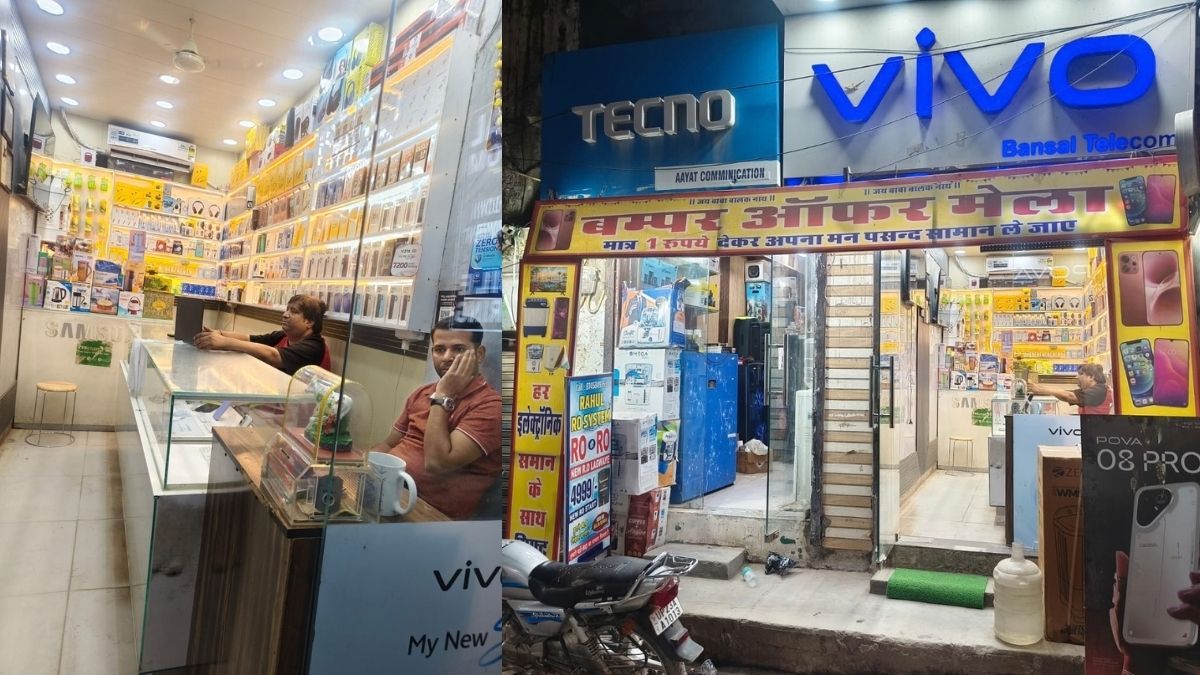
Smartphone shipments falling by 10 pc and a rise in average prices by 15 pc, adding pressure to already thin retail margins
Days after some shopkeepers in and around the National Capital Region openly displayed boards saying that they would no longer accept payments through UPI, the Indian digital payments interface, India’s mobile retailers are turning up the heat on their opposition to the proposed charge of 0.4 pc as Merchant Discount Rate to be applied to all UPI transactions above INR 2000 from October 15.
The All India Mobile Retailers Association (AIMRA), an apex advocacy body representing over 1,50,000 mainline mobile and electronics retailers across India, along with other trade bodies, plans to observe October 2 as “No UPI Day”, protesting the proposed MDR saying that the protest comes as the smartphone market is already under pressure.
Also Read: Despite government’s assurance, consumers set to bear brunt of UPI MDR costs
Smartphone shipments in India fell 10 pc year-on-year in the April-June quarter, the steepest decline for a June quarter in six years, while average smartphone prices rose about 15 pc as memory and component costs climbed says Counterpoint Research, a global technology market intelligence and industry analysis firm specialising in the TMT. It expects India’s smartphone market to decline 13 pc for the full year.
For retailers, the proposed MDR is therefore arriving alongside weaker demand, higher device prices and narrow margins. AIMRA says many mobile retailers operate with net margins of only 0.75 pc to 1.5 pc, leaving limited room to absorb another transaction cost.

Navneet Pathak
“Retailers are already dealing with several challenges, including weak consumer demand and the non-availability of products. Our net margins are often only around 0.75 pc to 1.5 pc. If a significant portion of our earnings goes towards MDR, how will we sustain our businesses? That is the biggest concern,” Navneet Pathak, National Joint General Secretary, AIMRA tells Media India Group.
The concern is particularly relevant to mobile retail because most handset purchases are above the proposed INR 2,000 threshold. Pathak says that the retailers were not opposed to digital payments but wanted the cost implications to be examined against the economics of the sector.
“When it comes to essential needs, phones have become an important part of everyday life. If the mobile industry is required to bear an additional 0.4 pc MDR, it could have a significant impact on retailers who are already operating on thin margins. The proposal therefore needs to be looked at from the perspective of the actual returns and costs faced by retailers,” he says.
In Q2 2026, shipments in the sub- INR 15,000 segment fell 45 pc year-on-year, while repeated price increases across entry- and mid-tier portfolios weakened demand. The research firm says memory prices had risen nearly fourfold since September 2025 and that memory and other component costs had prompted multiple rounds of price increases by smartphone manufacturers.
Chirag, who runs a mobile shop in Noida Sector 18, says customers were increasingly delaying purchases as prices increased.
“The demand for mobile phones has been declining and prices have gone up. We are already facing losses. With the latest iPhone launch, prices have gone up for other iPhone models as well. In this situation, it is very tough to survive with a 0.4 pc MDR when our margin is already very low. If this continues, we will have to think about closing our shops and looking for another livelihood,” Chirag tells Media India Group.
Also Read: NPCI expands UPI ‘One World’ wallet service to foreign inbound travellers
The concern extends across price segments, but is particularly relevant for smaller retailers dependent on volume. Counterpoint says smartphone financing accounted for more than 50 pc of mainline smartphone sales in India in Q2, indicating the extent to which financing is being used to support purchases as handset prices rise.
Rajesh Kumar, a mobile retailer in Lajpat Nagar, says that the proposed threshold did not reflect the economics of the trade.
“MDR should not be imposed on transactions as low as INR 2,000. If it is implemented at this level, our margins will come close to zero. We cannot increase our margins because demand is already slow and prices have already gone up. Customers are not willing to pay more, so there is very little room for us to absorb another cost. We are already struggling to sustain the business, and an additional MDR will put further pressure on small retailers. We want the government to look into the matter and consider the ground reality of the retail market,” Kumar tells Media India Group.
AIMRA Rajasthan has separately written to Union Finance Minister Nirmala Sitharaman, seeking an exemption from MDR for small and medium-sized mobile retailers. The Rajasthan chapter says it represents more than 12,000 small and medium-sized mobile retailers in the state, supporting approximately 96,000 families through direct and indirect employment.
In its representation, the association said the mobile retail industry was facing rising input and component costs, higher smartphone prices and declining consumer footfall. It claimed that business across mainline and general-trade retail had declined by around 40 pc. The association also claimed that prices in some smartphone segments had increased by as much as 70 pc, while entry-level 5G devices that were available at around INR 10,000 in 2025 were now selling at approximately INR 17,000.
These figures are industry estimates submitted by AIMRA Rajasthan rather than market-wide measurements. Counterpoint’s independent market data, however, also points to substantial price pressure. Its latest research says India recorded an average smartphone price increase of around 15 pc by the end of Q2, while its separate global analysis puts India’s smartphone retail price increase at 21 pc in 2026.
AIMRA Rajasthan has proposed that retailers processing up to INR 4 million a month through UPI should be exempt from MDR. Based on its calculations, a 0.4 pc MDR would mean an additional INR 4,000 a month on INR 1 million of UPI transactions, INR 8,000 on INR 2 million, INR 12,000 on INR 3 million and INR 16,000 on INR 4 million.
For a retailer operating on a net margin below 1.5 pc, the association says that the additional expense could consume a significant share of earnings. It has also sought wider consultation with retail associations before the framework is implemented.
“We are not against digital payments or the government’s efforts in this direction. Our concern is that the proposal should be reviewed with the interests of all stakeholders in mind,” says Pathak.
The issue has also moved into the courts. On September 28, the Supreme Court declined to stay the proposed MDR framework while considering a challenge to the 0.4 pc charge. The framework is scheduled to take effect on October 15, with a INR 300 cap on the MDR for an eligible transaction.
The protest is not confined to mobile retailers. Other business groups, including petrol-pump dealers, have also raised concerns over the proposed MDR and its impact on high-value digital payments. The broader trade-body opposition centres on whether businesses with thin margins should bear the cost of UPI transactions that have become an integral part of everyday commerce.
Also Read: Qatar launches new UPI route for remittances to India
For mobile retailers, the timing adds another layer to the dispute. Counterpoint expects the Indian smartphone market to contract 13 pc in 2026, with affordability remaining a key challenge as memory and component costs stay elevated.
AIMRA is seeking a review, exemption for small retailers and a consultation with the trade before implementation.
“What we are seeking from the government is clarity and a detailed review of the proposal. We want an opportunity to put the ground realities before policymakers and explain how the proposed MDR could affect retailers. We believe the government’s intervention and a broader consultation with stakeholders can help address these concerns,” says Pathak.