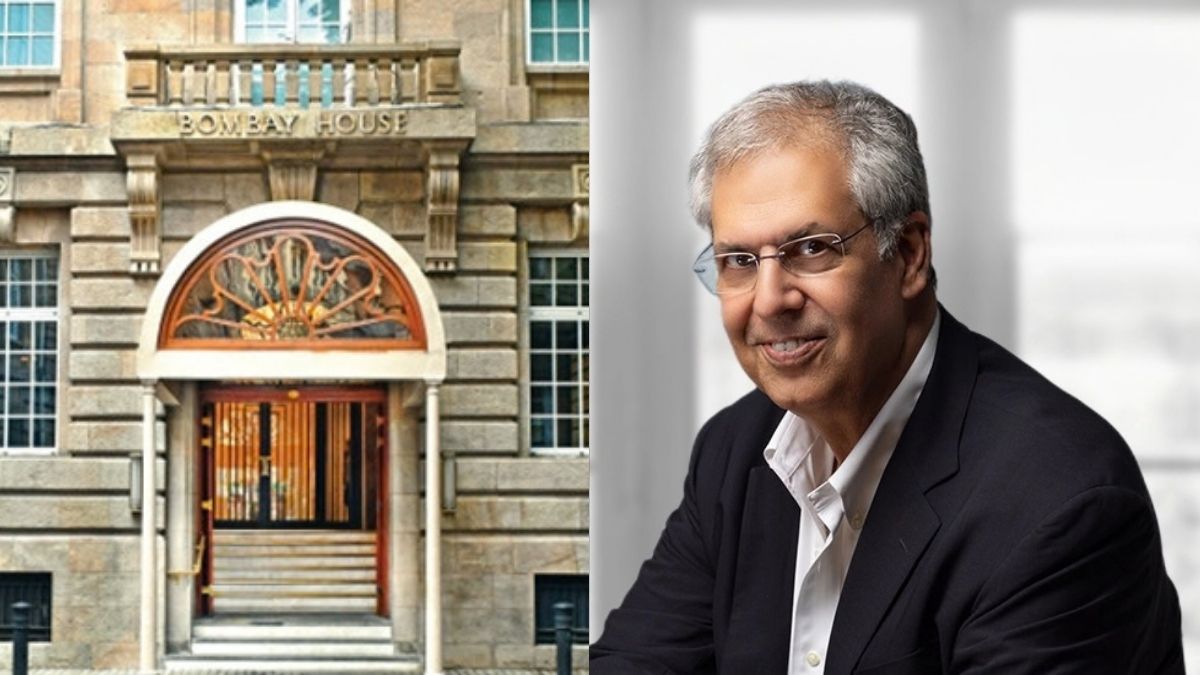
Bombay House, the headquarters of Tata Sons in Mumbai, at the centre of the dispute (Photos: Tata Trusts)
On September 17, Tata Sons, the holding company of the Tata Group, the largest and oldest business conglomerate of India, informed the stock exchanges that in a meeting its board of directors had decided to reappoint N Chandrasekaran by a majority vote as Executive Chairman for another five-year term.
The news immediately flared up into a major controversy as Noel Tata, the Chairman of Tata Trusts, a group of family trusts of the Tata family, immediately challenged the information sent by the board to the stock markets, saying that board made the announcement even though the directors had agreed not to disclose the matter until a legal opinion was secured, and a general meeting approved Chandrasekaran’s directorship.
Noel Tata said that the two Tata Trusts nominees on the board, including himself and Venu Srinivasan cast opposing votes, independent director Harish Manwani, who chaired the meeting, made the casting vote in favour of the reappointment.
Tata expressed his “serious disappointment” and “strong objection” to the board’s actions, saying that the board had no power to select a Chairman without the complete accord of the representatives of Tata Trusts, which between them control nearly two-thirds of stake and hence an overwhelming voting power also.
“At the outset, I record that I maintain that the vote taken on the captioned matter, and the entire process followed by the company in relation to it, was contrary to the Articles of Association of the company, and that any resolution claimed to have been passed is null and void ab initio and of no legal relevance, efficacy or effect whatsoever,” said Tata, adding that the board had used a different method to reappoint Chandrasekaran four years earlier.
Also Read: Ratan Tata’s legacy: Making Tata a global brand
“As those minutes record, that reappointment of chairman was effected under Article 118 of the Articles of Association,” Noel wrote, sharing the minutes. It is thus clear that for reappointment of chairman, the operative provision is Article 118. This material was plainly relevant to the vote taken on 17 September 2026 and was not placed before the board, which proceeded without it and at considerable speed,” he wrote.
In another letter, Tata said that the Tata Sons board had agreed to get a legal opinion to answer three questions: whether Article 118 applies to the chairman’s reappointment, whether the decision could be approved even though he opposed it, and whether the chairman’s deciding vote could break a tie.
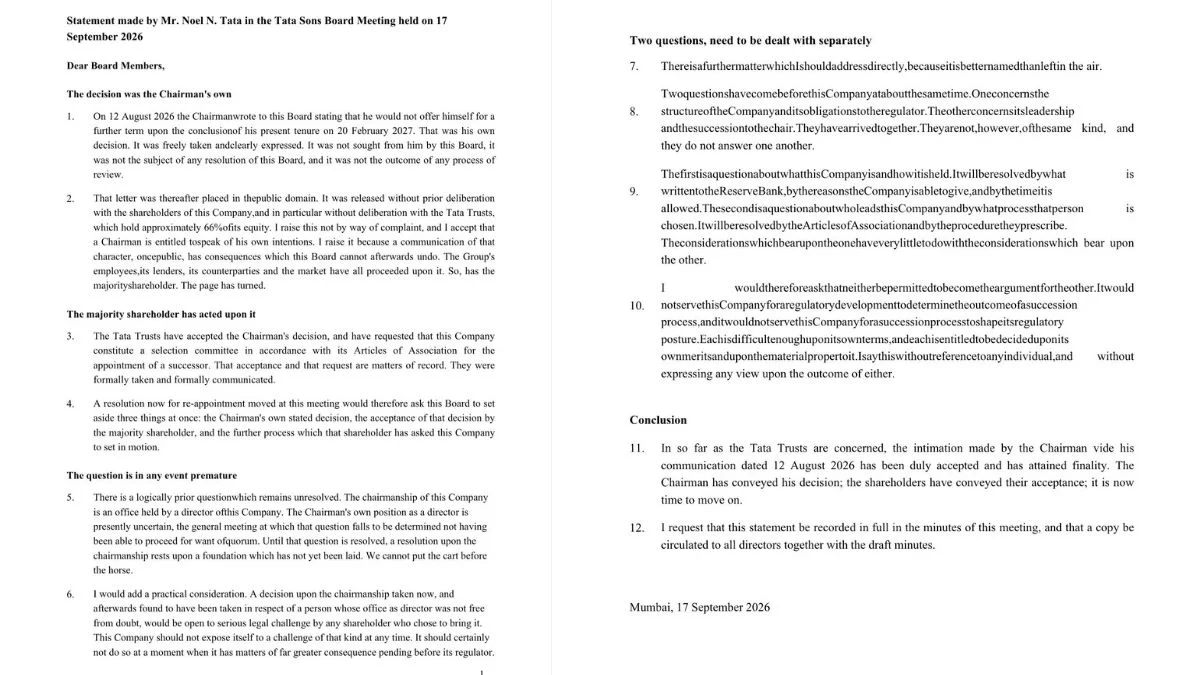
Noel Tata’s letter challenging the Tata Sons board’s decision to reappoint N Chandrasekaran as Executive Chairman (released by Tata Trusts)
Besides Chandrasekaran, Noel Tata and Srinivasan, the six-member Tata Sons board also includes group chief financial officer Saurabh Agrawal and independent directors Harish Manwani and Anita Marangoly George.
Tata added in his letter that the board had agreed that shareholders would need to approve Chandrasekaran’s reappointment as director at a properly held annual general meeting.
“It was further expressly agreed at the meeting that nothing would be disclosed to the public in relation to this matter unless and until both of the above conditions had been satisfied,” Tata said in his letter.
Preserving philanthropy over profiteering
The core of the issue lies in whether Tata Sons can retain its original structure, a private company with philanthropy at its heart. The company owns controlling stakes in all the Tata Group entities, whose total market capitalisation, is valued at around USD 305 billion.
In 2022, Tata Sons was classified as an upper-layer non-banking financial company (NBFC) by RBI, ruling that listing was mandatory, a decision was did not go down well in Bombay House and in March 2024, resolving to keep Tata Sons private, the board decided to repay borrowings and prematurely redeem preference shares aggregating approximately INR 200 billion, a decision Noel Tata said was taken not just to preserve its form, but to preserve its substance, that the core objective of the Tata Group remains centred around channelising profits into philanthropic activities.
The company later repaid its debt and applied to surrender its Core Investment Company (CIC) registration, but recently, on September 11, RBI rejected the application, saying that just by being debt-free does not take a company outside the regulatory framework. The rules also consider access to public funds, including funds accessed indirectly through group and associate companies.
According to protagonists of taking Tata Sons public, the company has other liabilities and its best interests can be served by seeking a listing. They point out that the Shapoorji Pallonji Group, which is the second largest shareholder after the Tata Trusts and hold over 18 pc stake, has decided to monetise part of its stake for about INR 250 billion.
Certainly the parent firm of the Tata Group can bear the cost of this exit. It has a net cash of INR 218 billion and it generated cash from operations of INR 255 billion with a net profit of INR 320 billion. Though it is not enough to ensure the exit of SP Group from the company, it is certainly not beyond its reach.
Moreover, how a privately-held company would finance its operations is largely a matter for the company itself and certainly neither the government nor the central bank has a say in this.
Also Read: GM Defense in ‘exploratory’ talks with Tata Motors for armoured vehicle
RBI’s insistence on Tata Sons going public hinges just on one rule that it has brought in a few years ago, that any Non-Banking Financial Company with assets exceeding INR 1 trillion needs to seek listing. While that rule may apply for normal NBFCs, Tata Sons is hardly an NBFC in the true sense of the word as it never deals with outsiders, companies or public. All its dealings are centred around the Tata Group and the philanthropic activities.
Moreover, when RBI began insisting on the company to go public, Tata Sons offered to surrender its licence as an NBFC, in which case the company would not be violating the RBI rule even on paper. However, for some undisclosed reason, the central bank rejected the offer and told the company to list.
By forcing Tata Sons to list, the RBI will undermine the very principles on which the Tata Group was founded over 160 years, with social responsibilities weighing over and above short-term and narrow commercial considerations.
Noel Tata rightly argues that a listed Tata Sons would become answerable to institutional and foreign shareholders whose legitimate mandate is financial return. Such investors may question the rescue of a distressed group company or resist continued funding of a venture that will take 15 years to mature.
And most importantly, the Tata structure has allowed patient capital to coexist with philanthropy and industrial ambition. The Tata Trusts’ majority ownership has also enabled dividends from commercial businesses to support hospitals, universities, research and social programmes.
The matter is certainly headed to the courts as Noel Tata is firm that he will not let anyone change the core objective of Tata Sons, which is not just to help the Tata Group grow, but also keep its philanthropic mission, set by its founder Jehangir Nusserwanji Tata in 1868, at the heart of its operations.
By insisting on a listing, the RBI risks destablising the country’s oldest and most diverse conglomerate and trying to force the country’s sole business house that is known for its equitable and philanthropic ways, the RBI is in no way helping bringing in better governance.
Moreover, RBI’s insistence is diametrically opposite to the concept of freedom of doing business or lesser government or regulatory interference in the way businesses are managed, as long as they follow the law. Moreover, it also flies in the face of a rising number of instances globally, where multi-billion dollar listed companies like Dell, Toshiba or Heinz, have been taken private by their owners, without violating any norms regarding good governance or corporate transparency.