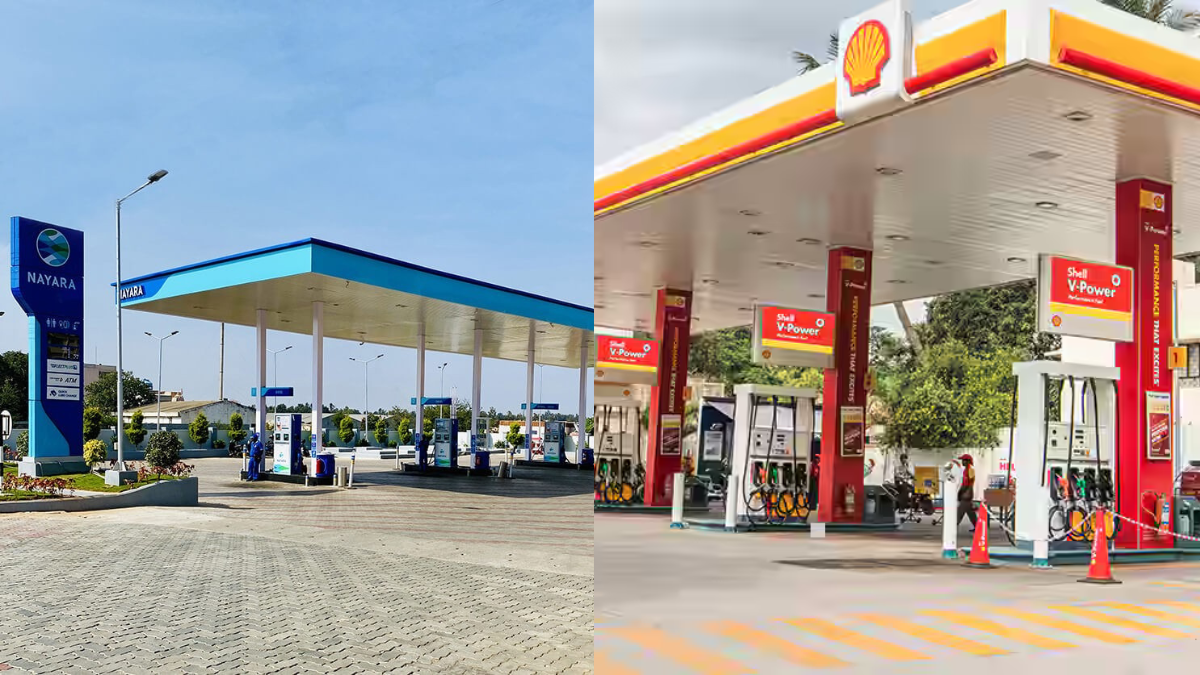
Nayara Energy and Shell India has increased petrol and diesel prices in India
Recently, motorists in cities across India were caught off guard by a sudden spike in fuel prices last week, It was not the familiar state-run oil marketing companies leading the charge; instead, smaller, private players like Nayara Energy, which operates India’s largest private fuel retail network with nearly 7,000 outlets and the second-largest single-site refinery at Vadinar, Gujarat and Shell India, with over 350 petrol pumps across the country, initiated the hike. For millions of consumers accustomed to months-long price stability, the move came as a surprise. More than a week later, it continues to signal not just the end of a prolonged freeze, but also the growing strain within India’s fuel pricing system as global crude markets surge amid geopolitical uncertainty.
At a petrol pump in South Delhi, Rakesh Kumar, 34-year-old cab driver recalculated his daily expenses on his phone, his expression a mix of resignation and concern. “Every INR 2-3 increase makes a difference. INR 5 at once it is going to hurt,” Kumar tells Media India Group, echoing the anxieties of transport workers, small businesses and middle-class households already navigating tight budgets.
The trigger for this shift lies far beyond India’s borders. Global crude oil prices have climbed nearly 50 pc in recent months, driven largely by escalating tensions in West Asia a region that remains central to global energy supplies. India, which imports over 85 pc of its crude oil requirements, is acutely vulnerable to such shocks. As prices of benchmark Brent crude inch closer to the USD 100-per-barrel mark, the cost of importing and refining fuel has risen sharply.
Also Read: 350.org urges Asian nations to tax oil windfalls as energy costs rise
Based on Petroleum Planning and Analysis Cell (PPAC) data, India paid USD 132.4 billion for crude oil imports in FY24 (April 2023–March 2024), down from USD 157.5 billion in 2022-23 due to lower prices, despite import dependency rising to a record 87.7 pc. While the 2023-24 bill was below USD 150 billion, high international prices in early 2026 threaten to inflate future costs.
For months, state-run oil marketing companies such as Indian Oil Corporation, Bharat Petroleum, and Hindustan Petroleum have absorbed these losses, effectively shielding consumers from global price volatility. Industry estimates suggest that these companies were incurring under-recoveries of INR 8–10 per litre on petrol and diesel at the peak of the crude price surge.
However, the companies had also failed to pass on the benefits of lower crude prices that have prevailed around the world for over a decade now and which reflects in their ballooning profits each year.
Nayara Energy’s and Shell’s decision to raise prices, therefore, is being viewed as a market correction one that reflects the actual cost pressures rather than political or policy considerations. Analysts say it could mark the beginning of a divergence in pricing strategies between private and public sector players.
Rahul Mishra, Indian Economic Service (IES) officer, underscores the structural nature of the issue. “The recent fuel price hike by Nayara Energy is largely a result of rising global crude oil prices, especially due to the West Asia situation. Since India imports most of its oil, companies eventually have to pass on these higher costs to consumers,” Mishra tells Media India Group.
Mishra says that the government has attempted to cushion the impact through fiscal interventions. After a 300 pc rise in excise duty on petrol and diesel in the period 2014-2021 and a sharp INR 10 per litre imposed just after Covid-19 pandemic outbreak in 2020, in the past three years, the government has rolled back some of the hikes, though excise levels remain much higher than they were in 2014.
Mishra says that while the cut in excise duty may moderate inflationary pressures in the short term, the strategy comes with trade-offs. Fuel taxes constitute a significant portion of government revenue. Sustained cuts in excise duties, therefore, strain public finances, particularly at a time when the government is balancing welfare spending with capital investment.
Also Read: With energy crisis, India real loser in US-Israel attack on Iran
“There are clear limits to this approach. Lower taxes mean lower government revenue, so if global oil prices remain high for a prolonged period, it becomes difficult to sustain this relief. In such a scenario, either fuel prices will rise further, or the government will have to absorb the cost, which has fiscal implications,” says Mishra.
The ripple effects of rising fuel prices extend well beyond the petrol pump. Transportation and logistics costs form a critical component of India’s supply chain, influencing the price of everything from vegetables to consumer electronics. A sustained increase in diesel prices, in particular, can push up freight rates, feeding into broader inflation.
Recent data from the Ministry of Statistics and Programme Implementation (MoSPI) shows that fuel and light account for roughly 6–7 pc of the Consumer Price Index (CPI) basket. However, the indirect impact is far greater, as higher fuel costs cascade through multiple sectors. Economists estimate that a INR10 increase in fuel prices can raise headline inflation by 20–30 basis points over time.
This presents a complex challenge for the Reserve Bank of India (RBI), which has been navigating a delicate balance between controlling inflation and supporting economic growth. While inflation has moderated in recent months, it remains sensitive to supply-side shocks such as fuel price increases.
“Higher fuel prices push up transportation and logistics costs, which then increase the prices of everyday goods. This adds to inflation and also complicates the policy stance of the RBI, which has to balance between controlling inflation and supporting growth,” says Mishra.
The divergence between global oil prices and domestic retail prices also raises questions about the sustainability of India’s current fuel pricing framework. Officially, India follows a market-linked pricing mechanism, where retail fuel prices are adjusted in line with global crude prices and exchange rates. In practice, however, prices have often remained static for extended periods, particularly around politically sensitive times.
Nayara Energy’s move could disrupt this equilibrium. As a private player with less direct exposure to government policy considerations, it has greater flexibility to align its prices with market realities. If other private retailers follow suit, it could increase competitive pressure on public sector companies to revise their pricing strategies.
Also Read: Indian MSMEs grapple with US tariff fallout
At the same time, the government faces a difficult balancing act. Allowing fuel prices to rise in line with global trends risks stoking inflation and public discontent, especially with elections to six states being held currently. Holding prices steady, on the other hand, places the burden on oil marketing companies and the fiscal system.
The stakes are particularly high for sectors such as transportation, Micro, Small, and Medium Enterprises (MSMEs) and exports all of which are sensitive to fuel costs. For small businesses operating on thin margins, even modest increases in diesel prices can erode profitability. Similarly, higher logistics costs can reduce the competitiveness of Indian exports in global markets.
Data from the Federation of Indian Chambers of Commerce and Industry (FICCI) suggests that logistics costs in India account for nearly 13-14 pc of GDP significantly higher than the global average of 8-10 pc. Rising fuel prices could push this figure even higher, undermining efforts to improve efficiency and competitiveness.
For consumers like Kumar, however, these macroeconomic dynamics translate into immediate, tangible concerns. “We don’t understand global markets. We just know that everything is becoming more expensive,” says Kumar.
Looking ahead, much will depend on the trajectory of global crude prices and the evolution of geopolitical tensions in West Asia. If prices stabilise or decline, the pressure on India’s fuel pricing system could ease. However, if the current surge persists, difficult choices will become unavoidable.
As Mishra puts it, “The longer prices stay elevated, the harder it becomes to maintain price stability without trade-offs.”