
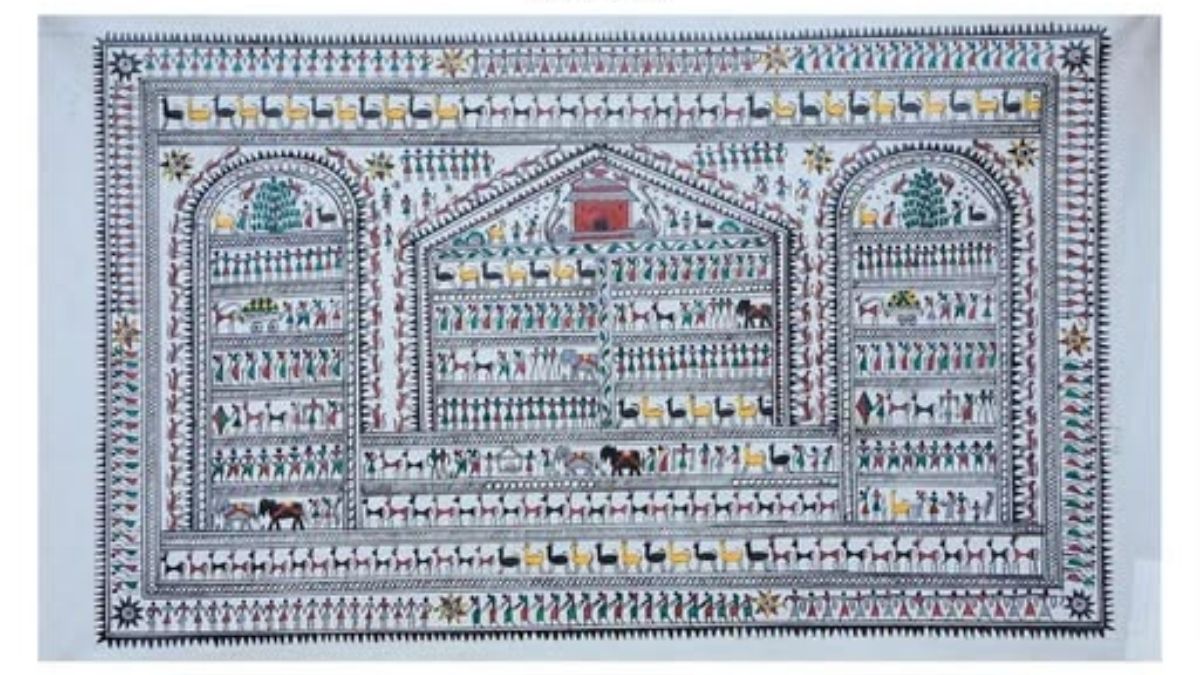
Human and animal figures frequently appear alongside representations of the natural and spiritual worlds (Photos: Ministry of Tribal Affairs, Government of India)
In the tribal landscapes of Odisha, the Saora community is predominantly found in the hilly and forested regions of the southern parts of the state, with significant populations concentrated in Gajapati and Rayagada districts.
For the Saora community, a wall becomes much more than a part of a home, as it serves as a canvas for stories about gods, ancestors, nature and unseen forces believed to influence everyday life. Known as Idital, this distinctive form of Saura painting is deeply rooted in the community’s spiritual beliefs, rituals and cultural traditions.
Unlike paintings created simply to decorate a space, traditional Idital works have a deeper purpose. Human figures, animals, plants, geometric patterns and other symbols come together to form a visual language through which the Saora people express their relationship with the spiritual world. The paintings have traditionally been associated with rituals seeking protection, good health, fertility, successful harvests and the wellbeing of families.
Also Read: Lunglei: Journey into the heart of Mizo culture
Tracing Saura art through the ages
The Saora people, one of Odisha’s indigenous tribal communities, have traditionally inhabited the forested regions of southern Odisha. Their cultural traditions have developed in close relationship with the natural environment, with forests, agriculture, animals, ancestors and spiritual forces occupying an interconnected place in their worldview.
At first glance, Saura paintings may appear to depict simple scenes of village life. But beneath the seemingly uncomplicated lines and figures lies a complex network of beliefs and stories. People, animals, plants, spirits and everyday activities are brought together to convey ideas that extend beyond what is immediately visible.
Human and animal figures frequently appear alongside representations of the natural and spiritual worlds. The meaning of a particular image, however, is not necessarily fixed. It can depend on the ritual, story or purpose for which the painting is created.
Also Read: Telangana’s Cheriyal scroll paintings: Stories of mythology and village folklore
This makes Idital more than a collection of decorative motifs. It is a way of expressing how the Saora community understands its place within the natural and spiritual world.
From ritual to the walls of the home
Traditionally, an Idital painting is created as part of a ritual rather than simply as an artistic activity. When a family faces problems such as illness, misfortune or concerns related to fertility and harvests, a ritual specialist may be consulted.
The preparation of the wall and the creation of the painting can form part of the ceremony. Traditional practices involve preparing the surface with natural materials before figures and symbols are carefully painted. Ritual offerings and other ceremonial practices may accompany the process.
Once completed, the painting assumes a special significance within the household. It is not merely an image on a wall but a representation of the relationship between the family and the spiritual forces in which the community believes.
The process therefore connects artistic expression with ritual practice, making the painting part of a larger cultural and spiritual experience.
Also Read:Durga Puja à Delhi : Préserver la culture bengali loin du Bengale
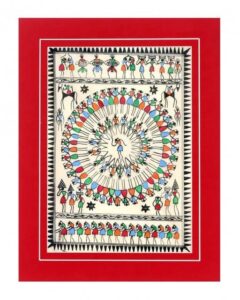
The paintings also hold particular importance as a means of preserving cultural knowledge
One of the most striking features of Idital is its ability to communicate complex ideas through relatively simple forms. Lines, circles and stylised figures are used to depict people, animals, spirits and elements of the surrounding environment.
The paintings reflect a worldview in which humans, nature, ancestors and supernatural beings are closely connected. Agricultural life, forests, animals and spiritual beliefs are not treated as separate subjects but as parts of one cultural landscape.
This visual simplicity can therefore be misleading. What may initially look like a basic representation of people or animals can carry meanings rooted in generations of collective knowledge.
Understanding Idital requires looking beyond the patterns themselves and considering the stories, rituals and beliefs that give those patterns meaning.
A tradition passed down through generations
The exact origins of Saura art are difficult to establish, and the tradition cannot be attributed to one individual artist or a particular group of creators. Instead, it has developed as a shared cultural practice, passed from one generation to another.
Also Read: Hemis Festival: Ladakh’s vibrant celebration of faith and culture
Much of this knowledge has traditionally been transmitted through oral traditions and practical learning. Successive generations of Saora artists have interpreted and adapted the designs in their own ways while retaining their connection to the community’s cultural worldview.
For this reason, Saura art is better understood as a collective cultural expression rather than the work of an individual artist.
The paintings also hold particular importance as a means of preserving cultural knowledge. Traditionally, the Saora language did not have a formal written script, making oral traditions, rituals and visual forms important vehicles for transmitting knowledge and memory.
In this context, the Saura art can be seen as a form of visual storytelling through which customs, beliefs and aspects of community life continue to be communicated across generations.
From sacred walls to contemporary spaces
Idital is no longer confined to traditional homes and ritual settings. Saora artists and cultural practitioners are increasingly taking the art to exhibitions, workshops, handicraft markets and contemporary art spaces.
The transition to paper, canvas and other modern surfaces has opened new possibilities for practitioners. It allows artists to reach audiences beyond Saora communities while creating opportunities to earn an income from their artistic traditions.
Also Read: Traditional jewellery: A dazzling tapestry of Indian cultures
The adaptation also introduces Idital to people who may never encounter the paintings in their original ritual setting.
Preserving more than the motifs
For many practitioners, preserving Saura art cannot simply mean reproducing its familiar figures and patterns. The stories, techniques, rituals and cultural knowledge behind those images are equally important.
If the visual motifs survive while their meanings are forgotten, an important part of the tradition could be lost. Passing the art to younger generations therefore involves more than teaching them how to draw. It also requires transmitting an understanding of why the paintings are created and what they represent.
This becomes increasingly important as younger members of the community encounter new forms of education, employment and artistic expression.
Also Read: Andretta: Hidden habitat of art and culture in Himalayas
At the same time, wider recognition can provide artists with opportunities to sustain the practice and introduce Saura culture to audiences far beyond Odisha.
Keeping a living tradition alive
The journey of Idital from sacred household walls to modern galleries is not simply a story of an ancient art form entering contemporary spaces. It is a story of adaptation, cultural continuity and the effort to preserve a distinctive worldview.
As Idital continues to evolve, its greatest challenge may be to embrace new audiences without losing the knowledge and beliefs that gave the tradition meaning in the first place.
