
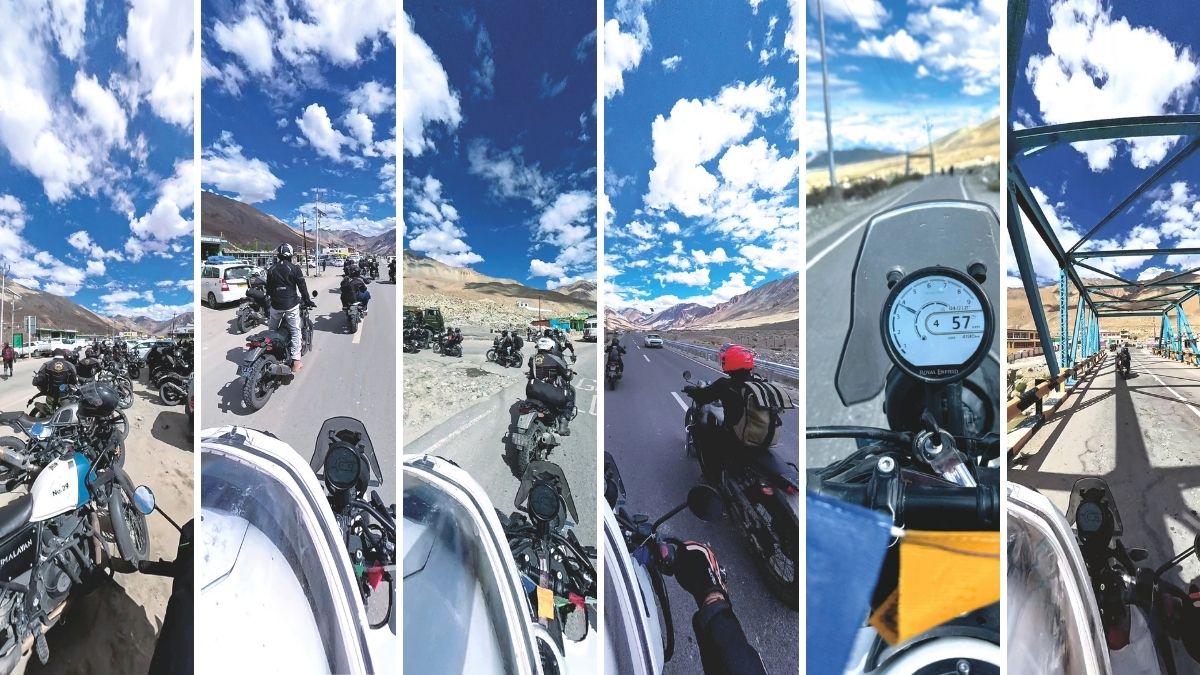
Bike trips in Ladakh have become legendary adventures (Photos: Partrick Allais)
I had fallen into a deep sleep on the early morning Air India flight from Delhi to Leh when a sudden commotion in the cabin woke me up. A passionate flight attendant was pointing outside, passengers were rushing towards the windows, and at one point I found three people from a group almost sitting on my lap, cameras in hand, trying to capture the spectacle below. Still half asleep, I slowly understood what was happening, we were flying over the Himalayas. And outside, the show was simply breathtaking. For once, I did not regret being woken up with a start.
I had left Paris, Charles de Gaulle the previous morning at 09:40, connected through Delhi after a three-hour wait, and was now watching one of the most spectacular approaches in the world unfold beneath me. The flight from Delhi to Leh is short, but from the sky it feels like crossing between two entirely different worlds. Delhi, the restless and sprawling megacity, and Leh, a modest mountain town tucked among the dramatic peaks of the Indian Himalayas.
Leh: First breath at high altitude
Landing at Leh airport immediately gives a sense of where you are. The terminal is tiny, the baggage carousels are human-sized, and the luggage arrives quickly. There is also a visible military presence, a reminder that Ladakh is a sensitive border region between India, China and Pakistan. After completing a simple entry formality for the state of Ladakh, it is easy to find a taxi to the city centre, around 10 minutes away, for about INR 500.
Also Read: Hunderman: Exploring Borderland Legacy of Ladakh
I am not new to India. I first discovered the country through my work about 15 years ago, mainly through repeated stays in Mumbai and Delhi. Over time, those first impressions expanded into secondary and then smaller cities, and eventually into a more authentic India, far from the noise and pressure of the megacities. My first real encounter with the Himalayas came at the end of 2025, after a visit to Amritsar, when a travel-agent friend from Mumbai suggested that I continue by car towards Dharamshala and Dalhousie. That journey whetted my appetite. Ladakh, by motorcycle, would be the next step.
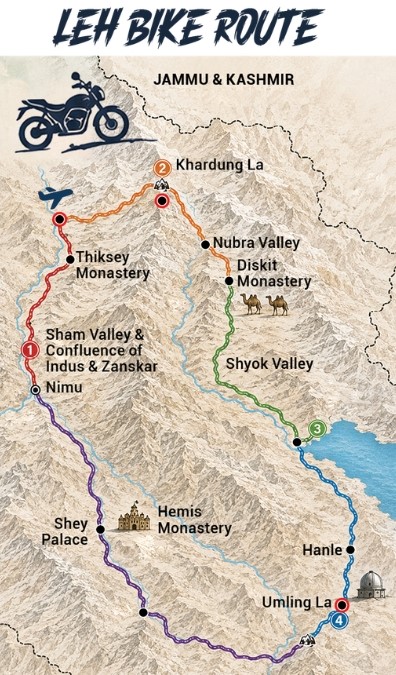
Leh Bike Route
I decided that the following summer I would ride through Ladakh on a Royal Enfield, the legendary Indian motorcycle. I booked my long-haul flights at the end of April, during a tense geopolitical period marked by conflict in the Middle East, and later reserved an eight-day motorcycle tour through Instagram with a local operator based in Leh. A few WhatsApp exchanges gave me confidence, although I still asked an Indian travel-agent friend to check the reliability of the company. The deposit requested was only around EUR 50, with the balance to be paid on arrival.
I arrived four days before the tour to acclimatise. Reaching Leh means arriving at around 3,500 to 4,000 m above sea level, depending on where one is staying, roughly the altitude of Europe’s highest summits. On the first day I had a mild headache, entirely manageable, which disappeared by early evening. It was the body’s polite way of reminding me that in Ladakh, enthusiasm must first negotiate with altitude.
Slow days in Leh
Like many tourist towns, Leh reveals itself best when one steps away from the obvious routes. It is easy to climb towards the old palace through the narrow streets of the old town, where families still live among stone walls, prayer flags and quiet courtyards. The city has a peaceful rhythm. Even the dogs, as in many Indian towns, seem to belong to the same extended family, calm, similar-looking and fully integrated into the landscape.
Cafés, tea rooms and small restaurants are everywhere and wherever I went, I found warm service, good English and quality food. As a coffee lover, I was particularly impressed by the single-shot espressos, which made me think that Leh has, at least for now, resisted the global marketing steamroller of certain international coffee systems. During my initial days, I also developed a serious addiction to apricot cheesecake. Paired with an espresso, it was perfection.
Also Read: Ladakh records 43 pc rise in June tourist arrivals
After spending my first night in Leh, I moved to the Ladakh Eco Resort, about 5 km from the central market. The setting was quieter, surrounded by nature and removed from the horns of the city traffic. Accommodation was in small wooden villas with private terraces overlooking the valley and the mountains. The food, including breakfast and dinner, was excellent, and the hospitality had the warmth and professionalism I often associate with India’s top hotel groups.
While looking for a clean and fresh place to swim near the resort, I met Fayaz, a local farmer. He owned a few cows, cultivated some land, and during the summer supplemented his income through tourism thanks to his excellent English. We spoke at length about overtourism, plastic waste and the responsibility of both visitors and locals. Fayaz had installed a large bag near the river so that people could dispose of their rubbish properly. It was a modest gesture, but also a meaningful one in a fragile environment where beauty and negligence can stand dangerously close to one another.
Day 1: Meeting the group
After three nights at the eco-resort and a few short rides around Leh to get used to mountain roads and left hand drive in India, the motorcycle tour operator picked me up in the late morning. I joined the rest of the group, mostly Indian riders from Mumbai, Bengaluru, Kolkata and other major cities, with an average age of around 30. All of them had come looking for adventure in the vast, stony landscapes of Ladakh.
Also Read: We want to make Ladakh a year-round destination
That evening, we gathered for dinner and a briefing on the week ahead. The first riding day would remain within a radius of around 40 km from the hotel, allowing everyone to get familiar with the bikes. Each participant received a helmet, a motorcycle jacket, and knee and shin guards. I had brought my own helmet, jacket and gloves, with the last being mandatory for motorcyclists in France, though surprisingly not in India.
Day 2: Sham Valley and the confluence of the Indus and Zanskar
Our first real day on the road took us from Leh towards Sham Valley and Sangam, where the Indus and Zanskar rivers meet. It was a gentle introduction: less than 100 km in total on the beautiful NH1. We stopped at a memorial maintained by the Indian Army in honour of soldiers who lost their lives in various Indo-Pakistani conflicts. In such places, there is often a small army-run café with very low prices, where tips are not accepted.
On the way back to Leh, we stopped at Shanti Stupa, one of the city’s essential viewpoints. Built in the 1980s by a Japanese Buddhist monk, it offers a spectacular panorama over Leh and the surrounding mountains. It was a fitting end to a first day that had been more about adjustment than endurance.
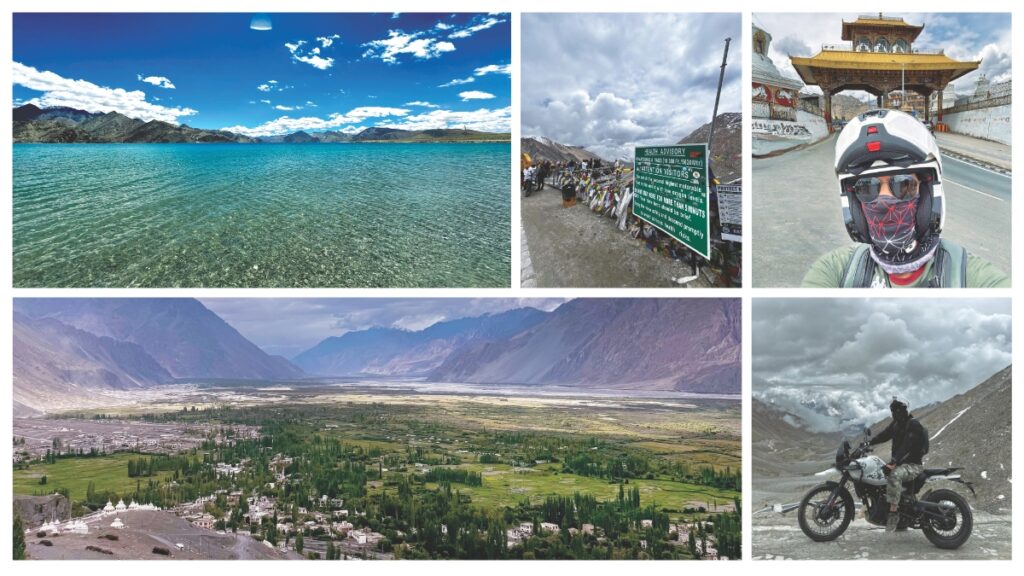
Pangong Tso (Top Left) is one of the largest Himalayan lakes. It is 134 km long and is renowned for its crystal-clear azure waters
Day 3: Khardung La and the Nubra Valley
We left at 09:00 towards Khardung La pass, climbing through sharp bends and increasingly dramatic scenery. The roads were generally good, although frequent works reminded us that in these mountains, maintaining a road is a permanent battle. Many workers, often women, seemed to operate with very limited technical means. At the top, around 5,600 m, the view over the valley and snow-covered peaks was magnificent. The air was thinner and colder, and it was clear why visitors are advised not to stay too long, even a few minutes at that altitude can feel like stepping off a roller coaster.
We then descended into the Nubra Valley and stopped at the impressive Maitreya Buddha statue below Diskit Monastery. Rising around 32 m, the statue was built between 2006 and 2010 and represents the Buddha of the future. Its purpose is symbolic and protective, to watch over the village, help prevent conflict with neighbouring Pakistan, and promote peace in the world.
Later, we reached one of the most extraordinary landscapes of the entire journey, at the sand dunes of Nubra, set at the foot of immense mountains. The contrast was surreal with desert, peaks, and Central Asian Bactrian camels creating the sensation of an oasis at the edge of the world. Signs warned of fines for people or organisations leaving waste behind. In my view, this should be generalised across all of Ladakh. After all, as many Indian tourists admire Switzerland, its discipline around cleanliness would be a worthy inspiration here.
Also Read: Galdan Namchot: Ladakh’s landmark winter festival
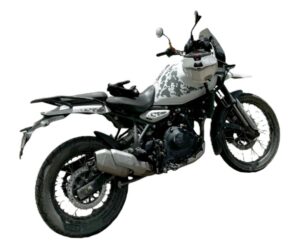
Royal Enfield Himalayan
We spent the night five minutes from this majestic place, in large and comfortable tents. To the sound of rain falling outside, I probably had my best night’s sleep of the entire trip.
Day 4: Through the Shyok Valley to Pangong Lake
The next morning, departure was scheduled for 05:30. Since the group was Indian and, culturally speaking, not always on the best terms with the clock, we left at 06:15. The programme was ambitious, a long ride through the Shyok Valley to reach Pangong Tso or Pangong Lake.
The road was magnificent. We saw different animals, including donkeys, yaks and others, wherever a patch of greenery allowed life to gather. The immensity of the Himalayas became almost difficult to comprehend, valleys stretching for several km, mountains rising endlessly, and snow still clinging to the highest ridges.
In the afternoon, we reached Pangong Lake, one of Ladakh’s most iconic sites. Sitting at over 4,300 metres, it stretches for roughly 134 km, with part of the lake in India and the rest across the border in Chinese-controlled territory. Its blue waters are hypnotic, although swimming and fishing are forbidden on the Indian side. Some spots have become famous through Bollywood films and now attract Indian tourists almost like places of pilgrimage.
We slept near the lake in a small village, with a direct view of the extraordinary blue waters. At that altitude, the nights are cold, quiet and strangely cinematic.
Day 5: From Pangong to Hanle
We set off in the morning towards Hanle, riding along Pangong Lake and passing close to the Chinese border. We stopped at a memorial dedicated to the 1962 war between India and China. Along the route, peaks above 6,700 m appeared in the distance, while border posts and checkpoints reminded us of the geopolitical sensitivity of the region.
Also Read: Turtuk: A hidden paradise in the Himalayas
We reached Hanle in the late afternoon after a long ride that included straight stretches where the Royal Enfields could finally breathe. The group was split across three different accommodations. I stayed for two nights in a tiny village attached to Hanle, in a brand-new hotel barely finished and clearly waiting for future travellers.
Day 6: Umling La and the sky above Hanle
The next day, the three subgroups reunited to ride towards Umling La, often described as the highest motorable road in the world, at an altitude of over 5,700 m. Reaching it required more than two hours of riding through mountains on dirt and stone tracks, where we crossed a few courageous mountain bikers. At such altitude, every movement becomes more deliberate, and even standing still feels like effort.
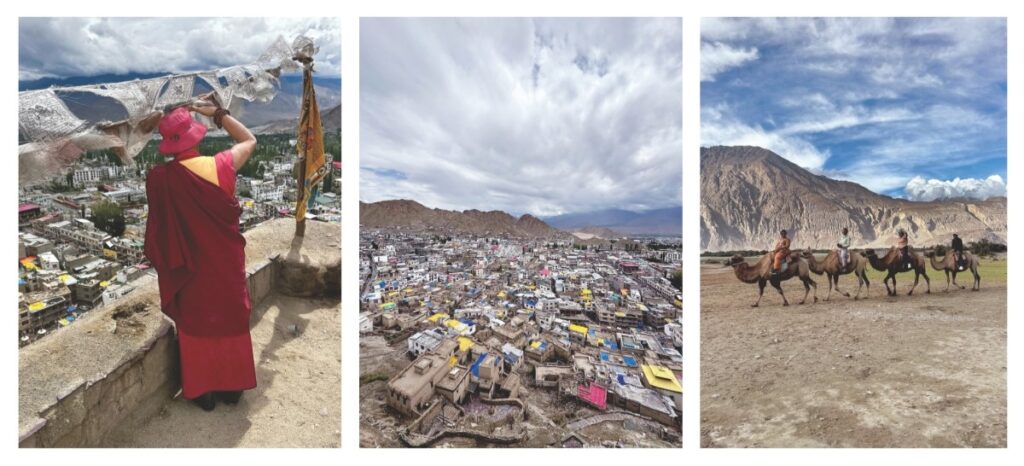
Double-humped Bactrian camels in Ladakh live in the Nubra Valley and serve as a major tourist attraction for cold desert safaris
On the way back, we climbed to the Hanle Astronomical Observatory, located at around 4,500 m. Hanle has become famous for its exceptional night sky and is known as India’s first Dark Sky Reserve. In a world where darkness has almost become a luxury, standing there felt like a privilege.
Day 7: Back to Leh along the Indus
Our final long riding day covered nearly 270 km back to Leh, following the Indus River. As throughout the journey, we passed many Indian military bases, constant reminders that the borders with China and Pakistan are not far away. Yet I felt safe during the entire stay; the military presence was noticeable, but never oppressive.
During a stop in a village known for hot springs, I struck up a conversation with an Indian family living in Dubai. The mother was wearing a fur coat, probably the first time I had ever seen an Indian woman dressed that way. She told me she travelled everywhere cold with that coat and considered Ladakh a cold region. Given the altitude, I could hardly disagree.
Before arriving back in Leh, we stopped at the Druk White Lotus School, also known as Rancho School thanks to its Bollywood fame. Tourism linked to the film has helped the school generate funds, supporting education for children from less privileged families. It was a reminder that cinema, tourism and social impact can sometimes meet in unexpectedly positive ways.
What made the trip work
Several things made the tour successful. The marshal knew the route and the territory perfectly, staying in regular contact with his local network to anticipate problems such as closed passes or changing road conditions. A support vehicle transported luggage, a mechanic was available in case of technical issues, and oxygen was carried in case any rider struggled with altitude.
Also Read: Nubra Valley: A hidden paradise in Ladakh
The roads were generally beautiful, though never to be underestimated. There were unpaved sections, falling stones, streams created by melting snow or rain, and sudden changes in surface. But this was also part of the experience. Ladakh is not a controlled adventure theme park; it is a living high-altitude territory, demanding respect from those who cross it.
The value for money was remarkable compared with similar products in Europe or North America. I paid the equivalent of EUR 0.5 for a shave and light haircut, EUR 0.1 for a lemon-ginger-honey tea, and around EUR 13 for a hotel night that would easily compare with a three- or four-star property in France. And then there were Leh’s unforgettable apricot cheesecakes and excellent espressos, small pleasures that became part of the emotional map of the journey.
Riding through Ladakh is not only about landscapes, even if the landscapes are among the most powerful, I have ever seen. It is about altitude, silence, discipline, humility and human encounters. It is about understanding that beauty can be immense and fragile at the same time.
(Patrick Allais is a travel professional based in Paris, who regularly visit India on work and holidays. The views expressed here are his own and do not necessarily reflect those of India & You)
