Industry leaders meet for the 4th international summit on AI regulation
As leaders of over 20 nations gather today in New Delhi for the AI Impact Summit, the fourth international gathering of global leaders to create uniform regulations to govern the development and deployment of Artificial Intelligence, it is imperative that they use this meeting to create a basic framework and begin the process of regulating a technology that is already creating havoc around the world in multiple ways.
That AI is a double-edged sword is already well-known and there have been innumerable examples of how it can be used and abused. Certainly, it can simplify many tasks which are laborious and not very productive and it can also speed up several processes which are too time-consuming.
But the gains, howsoevermuch they may mean to company bosses seeking to please their shareholders with higher profits every quarter, are too insignificant when contrasted with the real-time damage and destruction already being wreaked by AI across the world.
In terms of employment, AI threatens hundreds of millions of jobs and no amount of exaggerated reports by several AI development firms about the jobs that it can create can take diminish the fact that the jobs being taken away by AI are several times greater than the employment opportunities that the technology can create. AI is ultimately meant to replace humans with machines for various tasks.
For years, dozens of reports have been presented by various groupings of organisations, each making one outlandish claim after another on the power of AI and how they and others in their milieu are ready to harness the power of AI for good of the humanity.
Most the reports acknowledge that the technology was highly disruptive, with as many as 60 pc of workers vulnerable to it. But somehow, all the reports ended up claiming that AI would not only boost productivity and hence profitability of companies, but it would also in the longer run generate ‘far more jobs than it uproots, with numbers ranging from 12 million to 100 million’.
Also Read: AI Impact Summit: Disruptive Technology or Traumatic Asphyxia
Certainly, AI will create jobs, but they would be jobs for the highly qualified, well-educated people, while most of the jobs that it would destroy would be in the lesser-educated group of people, hitting at a section of the society that is not just the most vulnerable, but also the section that has been hit the hardest by a series of global events, starting from Covid-19 lockdowns to inflation and rising economic insecurity.
But a report by J P Morgan, a financial services firm, published in November 2025 says that AI’s long shadows have already started hitting the global jobs market.
“The unemployment rate among college graduates has risen, with majors exposed to AI, including computer engineering design and architecture, among those affected. In addition, job growth across several white-collar sectors has been tepid, pointing to AI’s growing role in the workforce,’’ says the report.
Worryingly, the J P Morgan report also found that certain technology industries, including cloud, web search and computer systems design, have stopped growing from the end of 2022, just after the release of ChatGPT, one of the leading AI tools being used around the world.
J P Morgan warns that as many as 300 million jobs are set to be sacrificed at the altar of AI within the next four years and this number is set to grow exponentially if AI continues to invade ever more parts of human society and the economy. Some estimates suggest that by 2050, as many as 80 pc of all jobs would be ‘transformed’ or automated, creating an unprecedented number of people who will be left looking for jobs.
According to a report by British charity Oxfam, in the last five years, the wealth of world’s five richest men has doubled, while over 5 billion persons or over 60 pc of the global population, have become poorer. The arrival of AI and its embrace by global businesses is set to worsen the deal for these 5 billion, while potentially generating trillions of dollars in additional profits and corporate dividends. And that is why it is imperative for the governments to step in and play a crucial role in minimising social disruption due to AI.
As corporate profitability around the world is at record high, often at eye-watering levels, the governments must make companies equal participants in ensuring that the workers rendered redundant by corporate adoption of AI are properly retrained or rehabilitated in other job roles and that their wages levels are protected, since there is enough historical evidence to show that workers displaced by automation end up becoming significantly poorer and that the impact of their impoverishment is felt for generations, rather than just stop with them.
Thus, not only should the companies be made responsible for retraining their workers to minimise job losses, but in case of a job being lost, the workers must also get their fair share in the profitability growth that the companies would reap. It may be time to ensure that the bosses also feel the heat of disruption, not just the workers.
Also Read: Artificial Intelligence: Transforming design, manufacturing and operations
Rising threat to environment
It is not just the jobs that are being severely impacted by the proliferation of AI. The technology poses an even bigger and ever increasing threat to the environment as it is entirely based on making ever-faster chips, in ever-increasing numbers and for a rising number of applications at data centres which are mushrooming around the world.
From hardware and software to simply running these data centres, AI has a voracious appetite for practically everything that is extremely harmful to the environment and which has only been accelerating climate change.
According to a report by the United Nations Environment Programme (UNEP), most large-scale AI deployments are housed in data centres, including those operated by cloud service providers. These data centres can take a heavy toll on the planet. The electronics they house rely on a staggering amount of grist as making a 2 kg computer requires 800 kg of raw materials. As well, the microchips that power AI need rare earth elements, which are often mined in environmentally destructive ways.
The second problem is that data centres produce electronic waste, which often contains hazardous substances, like mercury and lead. Third, data centres use water during construction and, once operational, to cool electrical components. According to an estimate, globally, AI-related infrastructure may soon consume six times more water than Denmark, a country of 6 million. This, at a time, when over a third of the world’s population is facing severe water challenges and over a quarter lacks access to clean water and sanitation.
Finally, UNEP says, to power their complex electronics, data centres that host AI technology need a lot of energy, which in most places still comes from the burning of fossil fuels, producing planet-warming greenhouse gases. A request made through ChatGPT, an AI-based virtual assistant, consumes 10 times the energy of a Google Search, reported the International Energy Agency.
It is estimated that as many as 3 billion queries are raised on all AI platforms everyday, consuming close to 1.1 GW of power every day.
The number of data centres has surged to nearly 10 million from 500,000 in 2012, and experts expect the technology’s demands on the planet to keep growing. With the rising number of data centres, use of power, which is still mainly through fossil fuels, will keep rising, as is the consumption of water.
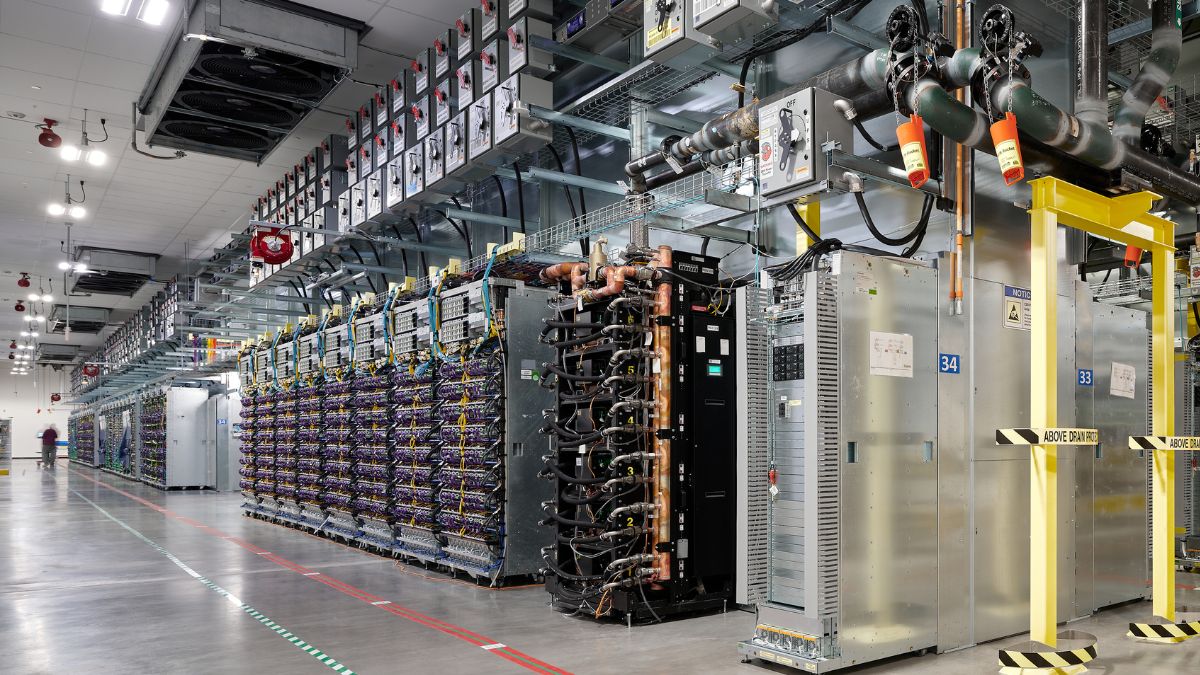
Google server aisles and coolant distribution units at New Albany data center campus in Central Ohio
Analysis by various media houses show that emissions from data centres owned by the Big 4 of the tech world, namely Alphabet, Meta, Microsoft and Apple, are almost eight times higher than what these companies claim and AI is expected to be responsible for 7 pc of total global carbon emissions.
Also Read: The natural cost of Artificial Intelligence
Ethical conundrums of AI
The challenges with AI are not limited to employment or the environment. AI poses an equally serious threat to social ethics with flagrant misuse or even abuse by a variety of players, ranging from organised crime and cybercriminals to paedophiles and blackmailers.
AI has come as a boon to cybercriminals who are using it to rob unsuspecting victims by posing as law enforcement officers or even a family member in trouble.

Cybercrime has surged since 2021, costing the country billions in 2025 amid rising digital fraud and AI-driven scams
According to various reports, AI is accelerating the speed and scale of fraud, contributing to a global cybercrime cost estimated to have reached USD 10.5 trillion annually by 2025.
India is specially prone to this as cybercrime in the country has surged by up to 400 pc since 2021 and is estimated to have cost over USD 3 billion in 2025, due to rising digital fraud and AI-backed scams, marking a significant surge in cyber-enabled financial crime. A report said that AI tools were involved in approximately 82.6 pc of all phishing emails, positioning AI in over eight out of every 10 phishing campaigns.
Add to these, the flagrant use of deepfakes, created by political parties and criminals alike, to either win elections, portray an opponent in unenviable situations or simply for blackmail. Women and children remain most vulnerable to deepfakes, especially those involving sexual crimes. And as if all these were not enough, recently Elon Musk’s Grok AI tool released an application which undressed any person’s photographs, leading to a global outrage.
The instances and the scope of these crimes is an unending one. And hence it is primordial for the governments to get together and ensure that the meeting in Delhi concludes on Thursday with a clear agreement on put limits on AI, its development and deployment.
A failure to reach this agreement, mainly under pressure of the Big Tech bosses that have also descended upon Delhi and if they fail to rein in Big Tech immediately, they would have failed not just the generations to follow, but the entire planet.