Nationwide strike by gig workers on Dec 31, against Q-commerce, falling pay
Workers seek government intervention for recognition of rights

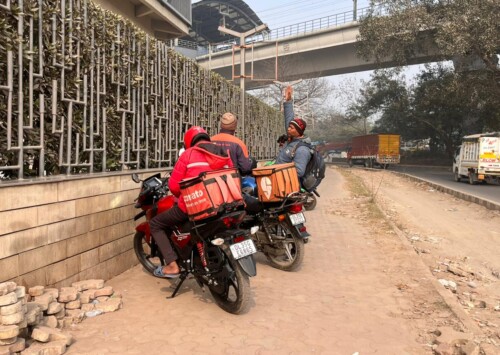
The strike is likely to attract participation by gig workers across Delhi-NCR and other cities (Photo: MIG/Amit Singh)
Thousands of gig workers across India are set to go on a nationwide strike on Wednesday in protest against shrinking pay, unsafe speed-driven targets and algorithmic control.
The strike is likely to attract participation by gig workers across Delhi-NCR and other cities (Photo: MIG/Amit Singh)
As India’s quick-commerce platforms promise ever-faster deliveries, gig workers say the race against the clock has turned dangerous and to emphasise their concerns, thousands of workers are likely to proceed on a strike across the country on December 31 seeking better pay and reasonable delivery times, instead of the increasing pressure by Quick Commerce companies for deliveries in 10 or even eight minutes.
The strike is likely to attract participation by gig workers across Delhi-NCR and other cities. Their demands spotlight the hidden human cost of a digital economy that rewards speed, convenience and growth while pushing workers toward exhaustion, road risk and economic precarity.
On a foggy late-December morning at Sarita Vihar in south Delhi, Anil Kumar, 45, stands beside his motorcycle, rubbing his hands together to fight the cold. Kumar has been logged into a grocery delivery app since 07:00, waiting for his first order of the day. The app promises “10-minute delivery” to customers. For Kumar, it means something else entirely, with unpaid waiting time, shrinking earnings and a constant fear of penalties.
“On paper, it looks like fast service. In reality, it has made our lives hell. I earn around INR 15,000 a month. From that, I pay for petrol, phone data, bike repairs everything. There is no fuel allowance. If I am late by even two minutes, customers shout at me, call me irresponsible. They don’t see the traffic, the fog, or the pressure,” Kumar tells Media India Group.
Kumar is one of thousands of gig workers who have joined calls for a nationwide strike, protesting what they describe as steadily worsening working conditions across food and grocery delivery platforms. The strike, backed by gig worker collectives and unions, has brought renewed attention to the human cost of India’s ultra-fast delivery economy.
Also Read: Fragile protections for workers weakened further by New Labour Codes
According to Nitesh Kumar Das, Organising Secretary of the Gig Workers Association based in New Delhi, the strike is not a reaction to a single policy but the result of “cumulative changes that have pushed workers to the edge.”
“Over the past year, platforms have quietly altered pay structures cutting per-order payouts, removing distance-based compensation, and shifting income into unstable incentive slabs. At the same time, unpaid waiting time has increased, and workers must stay logged in longer to qualify for incentives. Real incomes have fallen, while effort and risk have increased,” Das tells Media India Group.
According to NITI Aayog, a planning organisation of the union government, India has an estimated 7.7 million gig and platform workers, , a number expected to rise to 23.5 million by 2030. Food and grocery delivery workers form a significant share of this workforce, particularly in metropolitan regions like Delhi-NCR, Bengaluru and Mumbai.
Yet despite their growing numbers, for now gig workers remain outside traditional labour protections. Platforms classify them as “partners” or “independent contractors,” shifting most operational risks fuel, maintenance, insurance, health expenses onto workers themselves.
For many workers, the shift toward 10-minute or even 8-minute delivery promises has intensified algorithmic control over their daily lives.
Ravi is a 29-year-old delivery worker based in Chhattarpur in Delhi. He says that the app’s timer dictates every movement he makes.
“Once the order comes, there is no room for delay. Red lights, traffic jams, road diversions, nothing matters to the algorithm. If your acceptance rate drops or you cancel an order because it is unsafe, you are punished with fewer orders later,” Ravi tells Media India Group.
Also Read: No instant gratification for Q-com workers
Ravi recounts slipping on a wet road during last year’s winter smog season. “I hurt my knee and couldn’t work for three days. There was no compensation. No sick leave. No accident cover. If I don’t log in, I don’t earn,” Ravi adds.
According to data from the Ministry of Road Transport and Highways, India records over 150,000 road accident deaths annually, with two-wheelers accounting for nearly 45 pc of fatalities. While there is no official data segregating accidents involving delivery workers, unions say the pressure to meet unrealistic timelines significantly raises risk exposure.
In Delhi-NCR, these risks are compounded by environmental conditions. During winter months, air quality frequently falls into the “severe” category, with AQI levels crossing 400 in some areas. And this year, the air pollution has been particularly severe. Workers report breathing difficulties, eye irritation and fatigue, but say logging out during hazardous conditions leads to penalties or loss of incentives.
“There is no concept of hazard pay or slowdown during smog, heatwaves, or extreme cold. The risks are individualised, while profits remain collective,” says Das.
Beyond physical risks, workers describe emotional stress and rising customer hostility as another consequence of ultra-fast delivery models.
Suresh Meena, 34, who delivers groceries in South Delhi’s Saket area, says customer behaviour has worsened as delivery promises have shortened. “People track us on the app like we are racing. If we are late, they start calling, abusing, sometimes threatening to complain,” Meena tells Media India Group.
Meena says he earns between INR 14,000 and INR18,000 a month on average, depending on incentives.
Also Read: Karnataka’s ordinance promises rights, recognition for gig workers
“Incentives look good on posters, but they keep changing. One week you need 60 orders, the next week 75. If you miss it by one order, you lose everything,” Meena adds.
Worker collectives say such pressure erodes dignity and increases mental health stress. A 2023 study by the Indian Federation of App-based Transport Workers (IFAT) found that a majority of delivery workers reported anxiety related to ratings, incentives and fear of sudden ID deactivation.
“ID blocking happens without explanation. One complaint, one low rating, and suddenly you can’t log in. There is no hearing, no appeal system,” Das adds.
India’s new labour codes, including the Code on Social Security, 2020, formally recognise gig and platform workers for the first time. The law envisions social security schemes related to health, accident insurance, and old-age protection.
However, most of these provisions remain unimplemented on the ground.
“Recognition without enforceable rights means nothing. Workers are identified as gig workers, but platforms are not held accountable for safety, income stability or due process,” Das adds.
A meaningful outcome of the strike, he says, would involve rolling back unsafe ultra-fast delivery models, transparent pay linked to actual working hours and costs, assured work without algorithmic bias and social security benefits funded jointly by platforms and the state.
India’s quick-commerce sector has grown rapidly, driven by venture capital funding and intense competition. Industry estimates value the sector at over USD 3 billion, with growth projections tied closely to promises of speed and hyper-local fulfilment.
For consumers, the model offers unprecedented convenience. For workers and trade unions, the cost of that convenience is not something that the platforms, the society or the government bother to notice.
“Technology cannot be an excuse to bypass labour protections. Speed cannot come at the cost of human lives,” say Das.
Gig workers hope that as they raise their voices through protests and strikes, the country would stand up and take notice that India’s digital economy cannot run on invisible labour forever. Whether platforms and policymakers listen may determine the future of work for millions navigating the city streets one countdown timer at a time.