
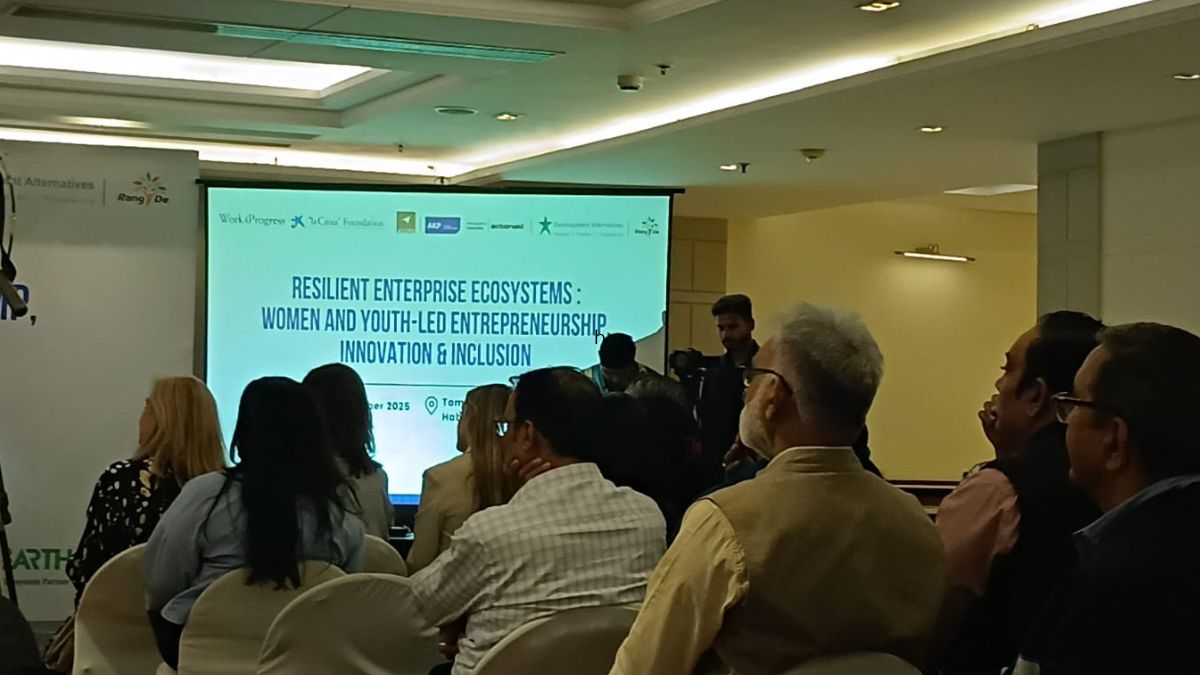
The annual conference saw discussions on how to create sustainable livelihoods while empowering women
Aiming to transform the employment landscape for women and youth, Work4Progress India, an initiative programme by Spanish La Caixa Foundation, recently hosted its annual conference in New Delhi.
Centred on the theme Resilient Enterprise Ecosystem: Women and Youth-led Entrepreneurship, Innovation, and Inclusion, the conference brought together policymakers, social entrepreneurs, development organisations, and grassroots leaders to explore how innovation and inclusivity can create lasting livelihoods for women across India.
According to the organisers, launched in 2017, Work4Progress India has spent eight years developing sustainable employment models for vulnerable women and young people.
Currently active across several states, including Eastern Uttar Pradesh, the programme focuses on creating inclusive systems that go beyond short-term job creation. It promotes community-driven innovation, social entrepreneurship, and financial self-reliance, all while encouraging women to take the lead in designing their futures.
Unlike traditional employment schemes, Work4Progress India does not rely on isolated, project-based solutions. Instead, it adopts a collaborative model aimed at long-term change. The approach begins with identifying the real needs of communities and co-creating innovative responses. It also involves exploring new financial instruments, communication tools, and strategies to build collective impact.
At the conference held, experts and participants reflected on the programme’s journey so far and its growing influence in reshaping rural enterprise.
Also Read: Women-led health-tech startups in India
Among those attending were Suhela Khan, Country Manager for the Women’s Economic Empowerment Programme at UN Women, Ved Arya, social development entrepreneur and Founder-Director of the Buddha Institute and Benjamin Mathew, CEO, Citta India Foundation. The discussion focused on how women and youth could drive innovation and resilience within India’s enterprise ecosystem.
“There has been a visible rise in the labour force participation of women, especially from rural India. However, only about 10 to 12 pc of women are currently engaged in the formal workforce,” said Khan of UN Women.
She added that while the numbers were improving, most women still faced barriers in accessing formal economic opportunities.
The panel also discussed the growing relevance of green livelihoods and whether environmentally sustainable enterprises can remain financially viable in the long term. Panel members also pointed out that the biggest challenge is still market access.
The discussion underscored that gender sensitivity cannot be treated as an afterthought.
“Gender must be intentionally integrated into the design of programmes rather than left for later consideration,” a panellist noted.
The panellists also agreed that real change requires challenging patriarchal structures within systems, not just within communities.
A beneficiary from Bundelkhand in Uttar Pradesh and a member of Work4Progress India, shared her own experience of transformation. Having joined the board of directors a year ago, she has seen significant growth in her community’s livelihood initiatives.
“We never had land of our own for farming. We used to work on small parcels earlier. Today, women in our village are engaged in organic farming, goat rearing and poultry farming, and our production has steadily increased,” the beneficiary told Media India Group.
She explained that her group now grows coriander, turmeric, and other crops, but no longer needs to travel to distant markets.
“Over 2,700 women in my village are currently involved in these enterprises. With the support of Work4Progress India, units for processing turmeric, coriander, urad, moong and chana have been established, along with a lentil-making unit. Many of these facilities are now powered by solar panels, a move that promotes both sustainability and self-reliance,” she added.
With better access to finance, training, and markets, these women have achieved a business turnover of around INR 10 million. Their products now reach customers in states such as Uttarakhand and Jammu & Kashmir.
“Initially, my family was not supportive of me doing this work. I had to convince my father-in-law a lot, but when he saw the growth and income, he started helping me,’’she said.
“This programme has helped me save money and build confidence. In the future, I hope we continue to receive support so that we can reach and empower more women,” she added.
