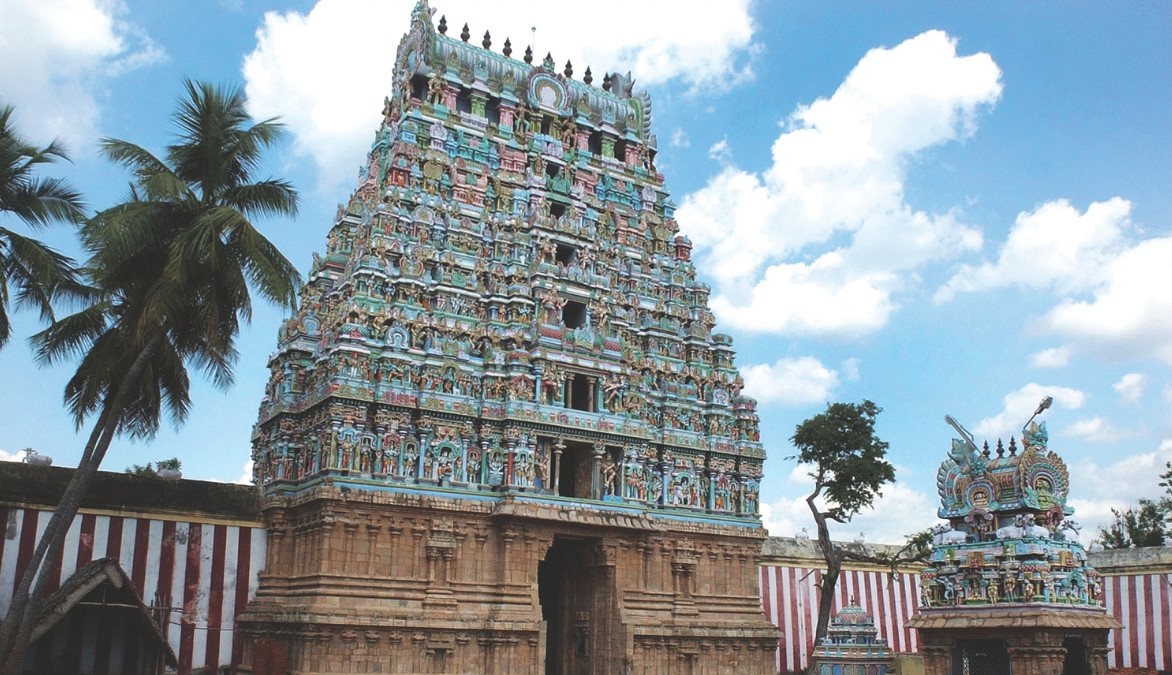
Tamil Nadu has four UNESCO World Heritage sites in total (Photos: Tamil Nadu Tourism)
Amongst the various attractions that peninsular India holds for visitors, one of the most prominent is the region’s marvellous temple architecture. All over southern India stand these gems of architectural, cultural and spiritual heritage and many of them have been recognised not just as part of Indian heritage but the heritage of the world.
One such group of temples, which has been recognised by UNESCO as World Heritage is Chola temples, three temples in the Kaveri delta that continue to remain in daily use more than 1,000 years after they were built. Priests still perform rituals inside them each morning, following practices recorded in Chola-era inscriptions on the temple walls. That continued use is the reason UNESCO lists them together as the Great Living Chola Temples.
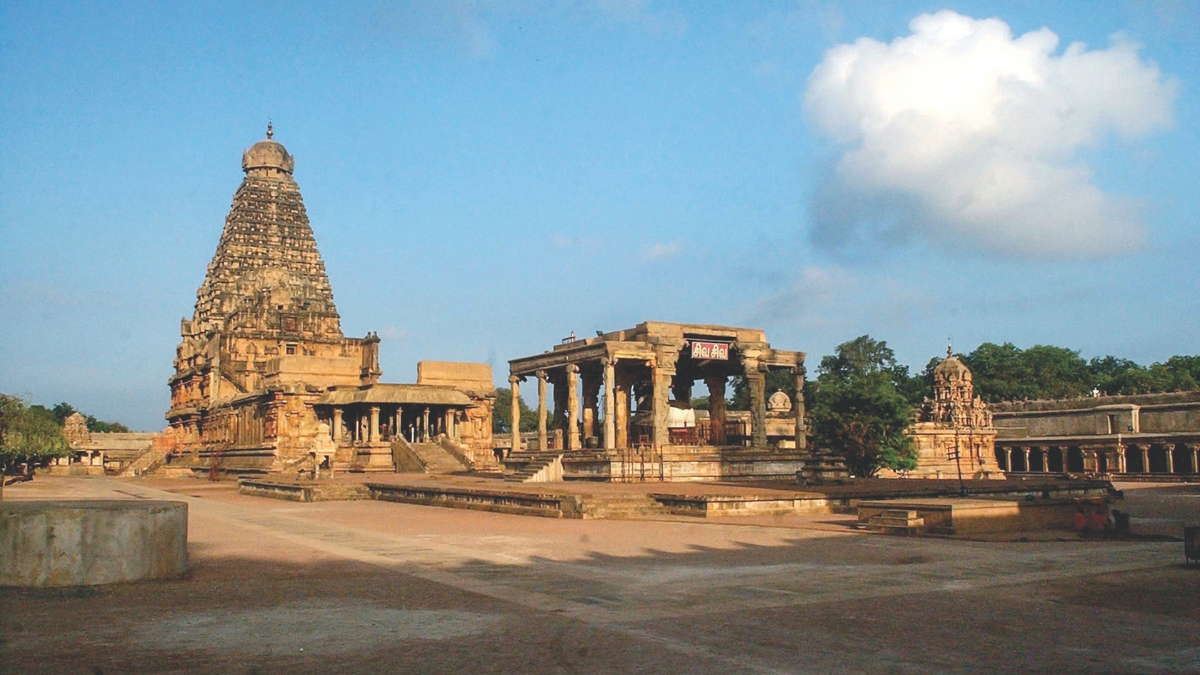
The Brihadeeswarar Temple, Thanjavur, a UNESCO World Heritage Site since 1987
The Chola dynasty is one of the longest-ruling dynasties in Indian history, with a documented presence going back to the Sangam period around the third century BCE and its peak of power between the ninth and 13th centuries CE. Its base was the Kaveri River delta in present-day Tamil Nadu, an area of fertile agricultural land that funded a large standing army, an extensive bureaucracy and a naval fleet.
Also Read: Gingee Fort: Tamil Nadu’s highly coveted hill-fort
The dynasty’s expansion is generally dated from the reign of Vijayalaya Chola in the ninth century, who took Thanjavur from the Muttaraiyar chieftains and established it as a Chola base. Later rulers, particularly Rajaraja Chola I (985– 1014 CE) and his son Rajendra Chola I (1012–1044 CE), extended Chola control across most of southern India and into neighbouring regions.
Rajaraja’s campaigns brought the Pandya and Chera territories, along with parts of Sri Lanka, under Chola control. Rajendra went further, leading a naval expedition across the Bay of Bengal that reached the Srivijaya empire in present-day Indonesia and Malaysia, one of the few recorded instances of an Indian dynasty projecting military power by sea into Southeast Asia. He also led a campaign north to the Ganga, commemorated in the name of the town Gangaikondacholapuram, which he founded as his new capital.
Historians estimate that the dynasty commissioned at least 300 stone temples across the Kaveri region during its peak. Many of those have not survived. Some were left unmaintained after later dynasties took over the region, some were rebuilt by the Nayaks and Marathas who later ruled Thanjavur, and a number of smaller shrines across the delta now stand without roofs, visited mainly by archaeologists. The Tamil Nadu Hindu Religious and Charitable Endowments Board currently lists 38,615 temples in the state, a number of which trace some part of their structure to Chola-era construction.
Three temples out of that wider record now form a single UNESCO World Heritage site. Tamil Nadu has four UNESCO World Heritage sites in total. Three of them are these temples, listed for architecture, sculpture and bronze casting from the same period. Thanjavur, Gangaikondacholapuram and Darasuram carry that listing together, and all three remain in daily use, with priests performing rituals that follow practices recorded in the temples’ own inscriptions.
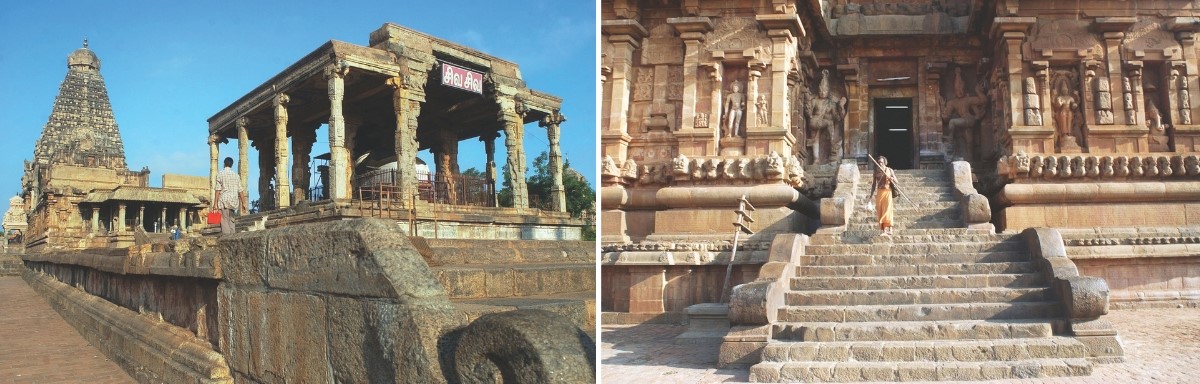
Granite halls and stairways at the Big Temple, Thanjavur, built by Rajaraja Chola I in the early 11th century
Citing its criteria for listing the Chola temples, UNESCO says that they show a progressive development of Chola architecture and art at its peak, and for standing as evidence of the dynasty’s work in building, carving, painting and bronze casting over roughly four and a half centuries.
UNESCO inscribed the Brihadeeswarar Temple at Thanjavur in 1987, then extended the listing in 2004 to include the temples at Gangaikondacholapuram and Darasuram. Together the three cover 21.88 hectares, with a buffer zone of 16.7 hectares around them. Rituals are performed daily, weekly and annually, following practices based on older Agamic texts.
The other Tamil Nadu entries on UNESCO’s list are the Group of Monuments at Mahabalipuram, inscribed in 1984 for Pallava-era rock-cut shrines, and two sites with a natural component, the Nilgiri Mountain Railway, part of the Mountain Railways of India listing, and the Western Ghats, a part of which falls in Tamil Nadu.
Thanjavur
Raja Raja Chola I began the Brihadeeswarar Temple around 1003 CE and completed it by 1010. He named it Rajarajeswaram; it is now commonly called the Big Temple, or Peruvudaiyar Kovil.
The vimana, the tower over the sanctum, stands 65 metres tall, among the tallest temple towers on record. It rises in 13 storeys, a stepped pyramid rather than a curved spire, which is the standard form in Dravidian architecture as distinct from North Indian temple design. At the top sits a single block of granite, octagonal, 7.9 metres wide, weighing an estimated 80 tonnes. No mortar holds it in place; the stones interlock. How workers moved that block to the top is not fully documented, though the commonly cited explanation involves an earthen ramp running several kilometres from the temple to the quarry, used to drag the stone up gradually.
Granite was not available locally. The Kaveri delta around Thanjavur is silt, not rock, so the stone came from quarries around 60 km away. Estimates put the total granite used at around 130,000 tonnes.
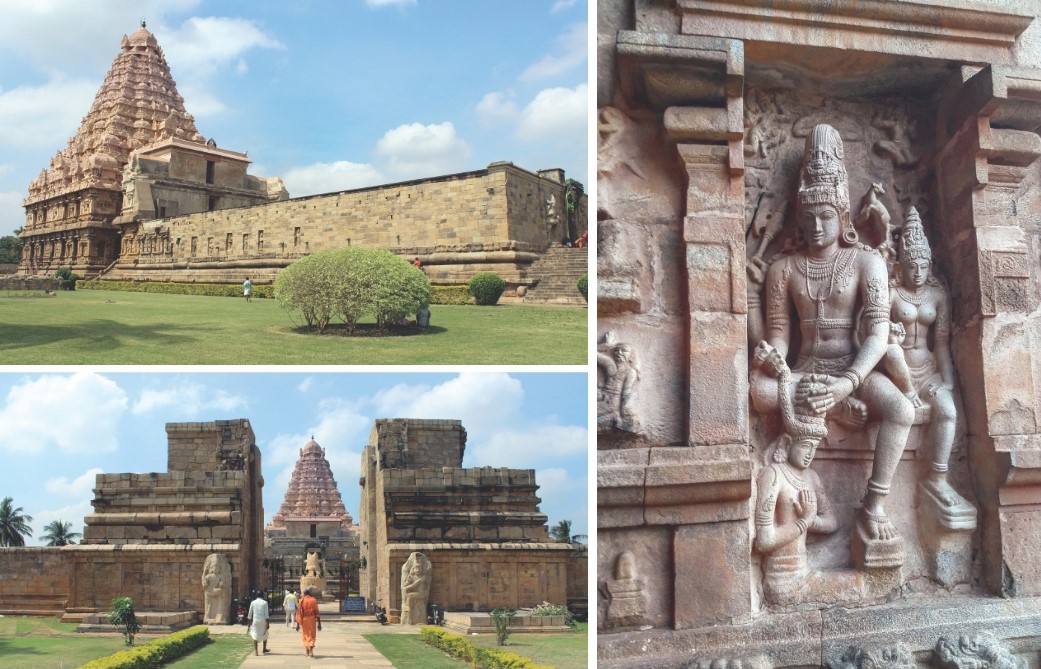
Gangaikonda Cholapuram, the capital Rajendra Chola I founded after his campaign to the Ganga, and the second of the three Great Living Chola Temples
At the entrance is a monolithic Nandi, the bull that is considered to be Lord Shiva’s vehicle, carved from a single block, measured at around 2.6 metres high and close to 6 metres long. Inside are Chola-era frescoes depicting Shiva as Tripurantaka, found beneath later layers of paint added by subsequent dynasties. The walls carry thousands of inscriptions, recording individual donations as well as villages assigned to fund the temple’s upkeep. The temple completed a thousand years in 2010, marked with public events across Thanjavur.
Thanjavur remains a major tourism destination in Tamil Nadu, with the district recording around 17.7 million tourist visits, according to Tamil Nadu Tourism Department statistics. The UNESCO World Heritage-listed Brihadeeswarar Temple is a major draw, attracting around 10,000 to 30,000 visitors a day depending on the season. The district has also recorded about 24.9 million domestic tourists and more than 350,000 international tourists during reported peak tourism periods.
Gangaikonda Cholapuram
Over 70 km from Thanjavur stands the second temple, built by Rajendra Chola I and completed in 1035. Rajendra moved his capital here after military campaigns that reached the Ganga in the north. The name Gangaikonda Cholapuram means “the town of the Chola who took the Ganga.”
The vimana here is 53 metres tall, shorter than Thanjavur’s, with recessed corners and a curving profile rather than the straight-edged form used by his father. Six pairs of statues of dvarapalas or guards, carved from single blocks, stand at the entrances. According to tradition, Rajendra brought water from the Ganga to his capital and commissioned a commemorative pillar, the Jalamaya Stambha, to record the successful military campaign.
Archaeologists have identified the remains of a palace attributed to Rajendra Chola southwest of the present town. The site was once the imperial capital, but now remains a small temple town.
Also Read: Tamil Nadu temples to restrict mobile phones from September 1
Gangaikonda Cholapuram’s Brihadeeswarar Temple receives around 9,000 to 10,000 tourists each month, according to Tamil Nadu Tourism Department and ASI data. Recent footfall has averaged over 1,200 visitors on weekdays and 5,000 to 6,000 on weekends, indicating increased tourist interest in the historic Chola-era temple.
Darasuram
The third temple, Airavatesvara, is at Darasuram, around 4 km from Kumbakonam. It was built by Rajaraja Chola II, dated to around 1166, more than a century after Thanjavur. Its vimana is 24 metres, the smallest of the three, but the carving is denser and more detailed than at the other two sites.
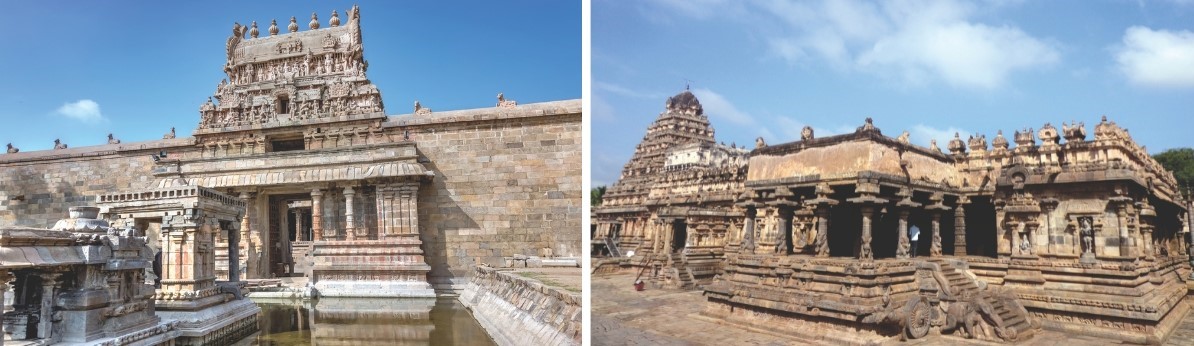
The Airavatesvara Temple at Darasuram, built by Rajaraja Chola II around 1166, with its chariot-shaped mandapa and densely carved walls
The complex includes shrines to Parvati, Yama, Subramanya and Saraswati alongside the main Shiva shrine, and a stone chariot mandapa at the entrance, with wheels and steps carved to resemble a temple car. Steps at the entrance are said to produce different notes when struck. The temple takes its name from Airavata, the elephant of Indra, said to have worshipped Shiva at this location.
Also Read: From Kashmir to Tamil Nadu: 5 hidden culinary gems of India
The three temples together span 160 years of construction. Thanjavur is built around one large tower with limited surface ornament. Gangaikonda Cholapuram follows a similar scale with a softer profile. Darasuram is smaller in height but denser in detail, built at a later, more settled point in Chola rule.
Getting there
Thanjavur is the usual base, around 350 km from Chennai by road, a journey of six to seven hours, or a shorter trip by train, with Thanjavur Junction connected to Chennai, Trichy and Madurai. Trichy’s airport, about an hour away, is the nearest with regular flights.
From Thanjavur, Gangaikonda Cholapuram is around 70 km by road, and Darasuram, near Kumbakonam, is about 40 km away. Most visitors cover all three temples over two days, using Thanjavur or Kumbakonam as a base. Early morning visits are recommended to avoid the midday heat, which regularly exceeds 35°C between March and June. November to February is a more comfortable period for visiting on foot.
Entry to the Thanjavur temple is free, though a small fee applies for camera use in some sections, and modest dress code is expected at all three sites. The Maha Shivaratri festival in February draws large crowds to Darasuram in particular.