
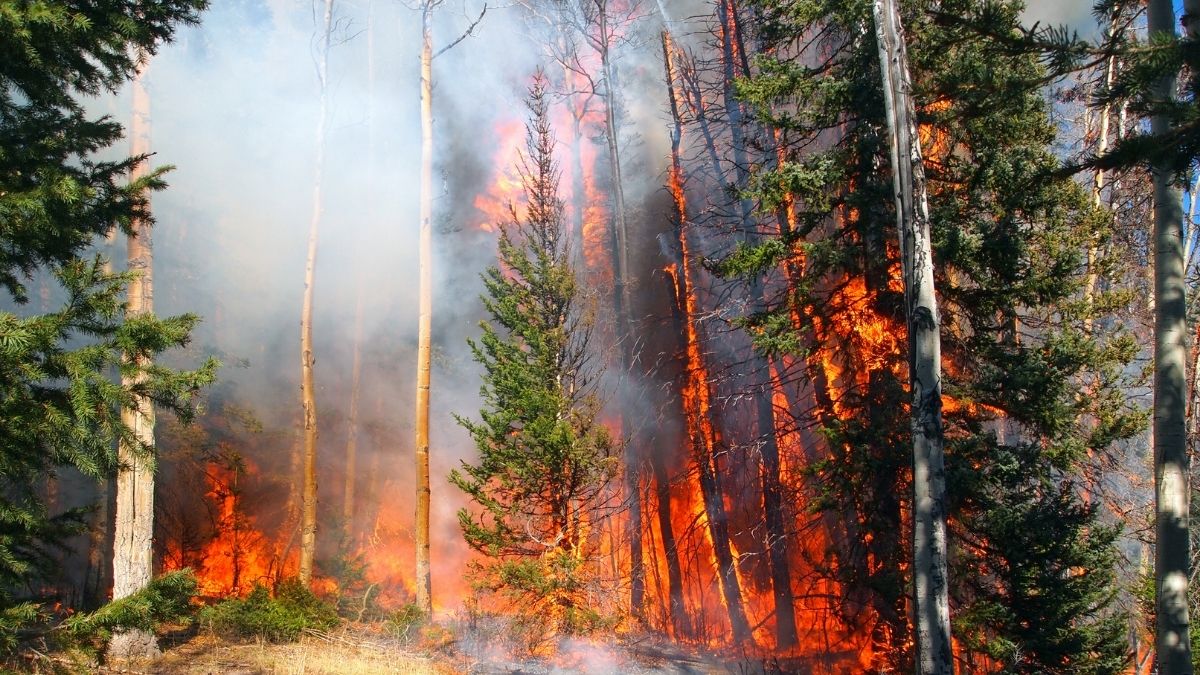
Wildfires highlight the climate crisis that today’s youth must be equipped to tackle as future climate implementers
In India, the youth are never too far from anyone, anywhere and at any time. For, India is home to the world’s largest pool of young population. Despite their numerical strength, the youth have rarely been as visible across the country as during the past several weeks, as thousands of them have descended upon the streets in protest against repeated leaks of critical examination papers, which threaten to derail their career.
But while a paper leak can derail an examination. A climate crisis can derail an entire generation. The first demands accountability in an education system. The second demands not resignation but redesigning the systemic-transformation of almost every system that education prepares young people to enter.
This is not to compare the seriousness of a paper leak with a heatwave, flood or wildfire. It is to recognise something deeper, that today’s young people are inheriting multiple crises at once and we are still educating them largely for yesterday’s world!
And on the Independence Day, which followed the International Youth Day, the contrast could hardly be sharper. Young people are studying, competing for jobs and demanding integrity in education while simultaneously watching their future being reshaped by extreme heat, floods, wildfires, water stress and climate disruption. The World Meteorological Organisation has warned that the developing El Niño could henceforth in remaining 2026 increase the likelihood of heatwaves, droughts, heavy rainfall and other extreme events .
The question, therefore, is no longer whether young people should be involved in tackling climate change. The question is whether we are giving them the institutions, skills and opportunity to do so. That is why an important new partnership is being announced on 13 August.
The Green Terre Foundation (GTF), initiator of the Smart Campus Cloud Network (SCCN), and YOUNGO Energy, the energy-focused working group of YOUNGO, the official youth constituency of the United Nations Framework Convention on Climate Change (UNFCCC), have initiated a unique partnership to put the focus not just on paper leaks but also energy, water and waste leaks that not only cost to economy but result in life-threatening climate crisis. They together have devised University Determined Contributions (UDCs), mirroring Nationally Determined Contributions (NDCs) and will nor launch global movement to engage Gen Z from universities and higher education institutions.
Unfailing-resolve and fully-demonstrated potential of Gen Z would be now channelled to meet the existential crisis of climate change.
Also Read: Climate crisis in India: Extreme weather forces millions from their homes
The missing link in climate implementation
The Paris Agreement of 2015 gave the world a powerful mechanism in the form of NDCs, under which countries determine their climate ambitions. But ambitions become real only when they are translated into measurable implementation starting with sketching road-map, taking decisions, deploying technologies, making investments, developing skills and behaviour through experiential learning. The implementation gap is not only a financing gap or a technology gap. Increasingly, it is a human-capital gap.
There are several questions facing the world. Who will measure emissions? Who will design Net-Zero buildings? Who will manage renewable-energy systems? Who will plan climate-resilient cities? Who will develop carbon-accounting systems? Who will use AI and digital technologies responsibly for climate solutions? Who will help communities adapt to heat, floods and water stress?
The answers to these complex and crucial questions cannot and should not come from governments alone. Nor can they come from industry alone. The responses must come from the future guardians of the Earth, the youth, and their educational institutions that produce the next generation of engineers, scientists, managers, architects, lawyers, entrepreneurs, policymakers and community leaders that later get connected to government and the business.
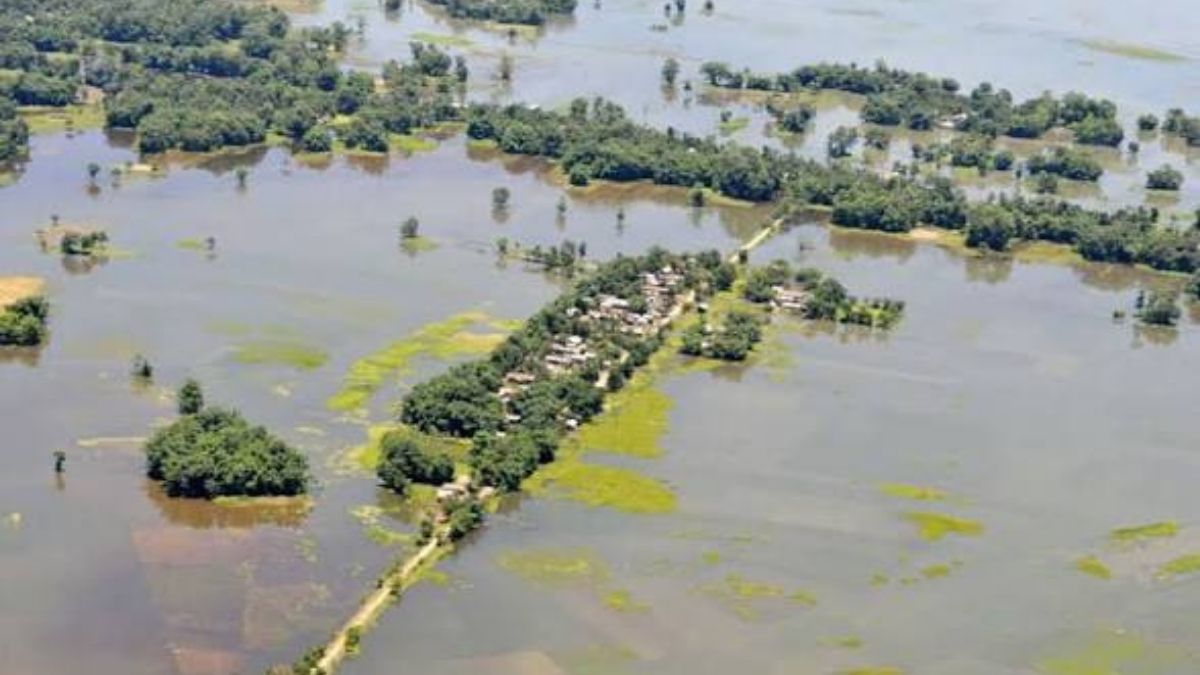
Floods underscore the urgent need to turn universities into living laboratories for climate action and resilience (Photo: PIB)
With hundreds of millions of students and enormous research capacity, universities are among the world’s most underused climate infrastructures. Walking the talk of Net Zero is economically beneficial as amply proved by solar energy and has potential in the world of AI and digital infrastructure to become a reality of full employment of the youth including in business and government and even leaders in start-ups. This exactly is the premise behind UDCs.
Also Read: Indian coasts face fast-moving climate crisis, warns Azim Premji University
From NDCs to UDCs
A Nationally Determined Contribution says, in effect that “This is what our country intends to do”. A University Determined Contribution asks “What will our university actually do, and what will its students learn and get skilled by doing it?”
The UDC concept was developed by GTF within SCCN and proposes a voluntary, structured framework through which universities define, implement, measure and periodically strengthen climate commitments aligned with NDCs, the Sustainable Development Goals and the Paris Agreement.
It was first proposed in a virtual-COP organised by YOUNGO Energy in 2025 just before COP30 in Belem in Brazil. Ovais Sarmad , mentor of GTF/SCCN and former Executive Secretary of UNFCCC proposed it and it was agreed.
A UDC could begin with a greenhouse-gas inventory and a Net-Zero roadmap for universities . It could then encompass renewable energy, energy efficiency, sustainable mobility, water conservation, waste reduction, biodiversity and climate resilience. But stopping there would fall short and miss the real opportunity.
The most valuable asset on a campus is not its solar panels or green buildings. It is the young human-mind , the enormous potential of Gen Z . A UDC therefore places experiential learning at the heart of implementation.
For instance, an engineering student can audit campus energy use, while a student of architecture can design cool spaces to deal with extreme heat. An innovating science student can find a solution and mount a start-up for passive cooling to reduce the vast investments currently needed. Similarly, a business student can explore climate finance, a computer-science student can build digital monitoring tools for real-time and online measurement and a law student can study climate governance. Students from agriculture, health, economics and social sciences can work on adaptation, food systems, public health and community resilience. The campus indeed is a living laboratory. The student becomes not merely a recipient of climate knowledge, but a climate practitioner. That is the shift we urgently need.
Also Read: Cockroaches not pests, primordial for biodiversity
Not another dialogue, Gen Z needs a mission
The youth have already demonstrated that they can mobilise society and shake the system. They can also influence climate discourse. YOUNGO itself is recognised by the UNFCCC as an official game-changing constituency, providing a channel through which young ones contribute technical and policy inputs and participate in climate processes. But advocacy alone cannot deliver Net-Zero. The ambition should not be to create a collection of isolated “green campuses”. Here comes SCCN as a catalyst to create a network of learning campuses.
A university in India should be able to learn from one in Africa or a Latin American campus should be able to adapt an innovation developed in Asia. Universities should be able to compare pathways, learn from failures, share data and accelerate solutions. This is where SCCN can play a distinctive role with the over 640 campuses in 24 countries in its network in Africa, Latin America, India and China.
Its purpose is not simply to make campuses greener. It is to connect campuses so that green skills, climate solutions and implementation experience travel faster than the climate crisis itself. The proposed Global University Climate Action Platform could eventually provide an institutional home for such learning, allowing universities to register UDCs voluntarily, report progress, exchange experience and build partnerships for technology and climate finance.
If we give young people campuses that function as living laboratories, real problems to solve, real data to analyse, real technologies to test, real communities to serve and real pathways into decision-making, they will give us something far more valuable than another generation of climate advocates. They can give us a generation of climate implementers.
And perhaps that is how we can move from paper leaks to climate breakthroughs, from an education system that prepares young people to pass examinations to a generation prepared to pass the planet on, intact, to those who come after them.
(Rajendra Shende is a former Director UNEP, Founder Director Green TERRE Foundation, coordinating lead author, IPCC that won Nobel peace prize, Prime Mover SCCN, IIT Alumnus. The views expressed here do not necessarily reflect those of Media India Group.)
