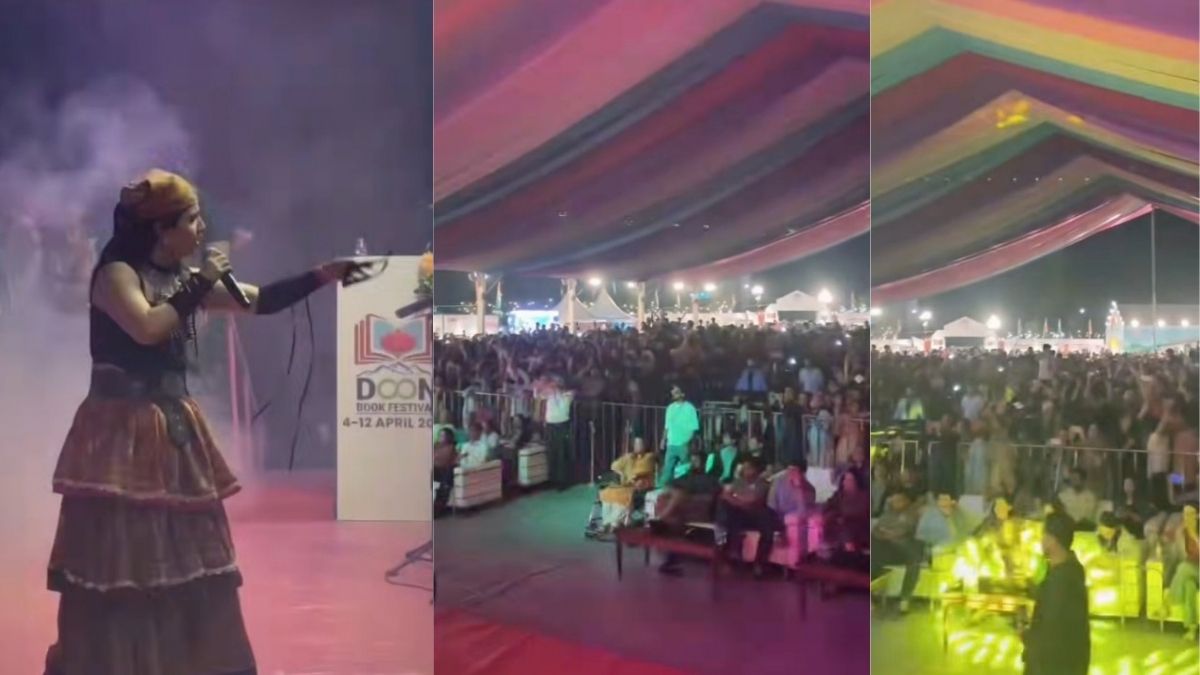
A loud music and dance event held near the Badrinath shrine sparked widespread backlash from priests, politicians, and devotees over the sanctity of the sacred pilgrimage site
The ongoing controversy over a music festival organised at Badrinath, part of the Char Dham or the four holiest pilgrimage sites of Hinduism, located in an ecologically-sensitive part of the Himalayas, is no longer only about religious sentiment. It has raised questions over why a high-decibel, concert-style programme was allowed to be organised in a high-altitude Himalayan zone, whether its environmental sensitivity was adequately considered, and who ultimately gave the permission for the event.
The Devbhoomi Cultural Festival, held on September 19 and 20 at the Tourist Arrival Plaza in Badrinath, was organised under the Indian Army’s Operation Sadbhavana, in partnership with the Chamoli district administration and Uttarakhand Tourism. The stated objective was to showcase Uttarakhand’s folk culture, handicrafts, local products, traditional food and the traditions of villages along the border.
But videos from the event showed amplified music, dancing and a performance by Uttarakhand singer Priyanka Meher, with reports describing the sound system as a high-decibel DJ style. The footage triggered criticism over the appropriateness of such an event at Badrinath, one of India’s major pilgrimage centres.
Also Read: Uttarakhand government reimposes bans on mobile phones, ‘VIP Darshan’ in Chardham
Badrinath is one of the Char Dham pilgrimage centres and sits in the high Himalayas. Its religious significance is one reason the use of loud music has become particularly contentious.
BJP veteran and former party president Murli Manohar Joshi criticised the event, saying that permitting a music concert or DJ event at Badrinath violated the cultural and religious decorum of the shrine. He also pointed to the traditional prohibition on blowing a conch at Badrinath and questioned the decision to hold a loud musical event there.
Joshi’s intervention is significant because the criticism is not confined to opposition parties or religious groups. A senior BJP figure has also questioned the appropriateness of the event and called for such programmes to be prohibited at sacred pilgrimage sites.
The event organisers, however, have maintained that it was not simply an entertainment programme. Sunil Purohit, Executive Officer of Badrinath Nagar Panchayat, told media that the festival was an official civil-military integration and socio-economic initiative, held at the outer tourist arrival plaza rather than the core temple area.
There is a long-standing local belief that even the sound of a conch should be avoided at Badrinath because of the possibility of avalanches in the surrounding mountains. A 2025 report by The New Indian Express quoted a local priest saying that the prohibition on the conch is connected to both religious tradition and concerns about vibrations in the surrounding mountainous region. Environmentalist and Chipko movement leader Chandi Prasad Bhatt has also highlighted the avalanche vulnerability of large parts of Badripuri outside the main temple area.
However, loud music is not the only serious environmental threat in the region. The environmental concern is broader and relates to the sensitivity of the Himalayan landscape, the impact of human activity and the need to assess the carrying capacity of such locations.
Environmentalist Professor S P Sati, speaking to media said that Badrinath’s hanging-glacier environment makes excessive noise particularly concerning. He said loud sound should be avoided in such areas and linked the issue to the vulnerability of glaciers and the effects of growing human pressure, traffic and black carbon in the Himalayas. He also called for carrying-capacity assessments for Himalayan pilgrimage sites.
Also Read:Asego launches ‘Pilgrim Protect’ for enhanced safety on Char Dham Yatra
His comments put the concert into a wider environmental context. The question is not simply whether a particular song or sound can cause an avalanche. It is whether a fragile high-altitude destination should be subjected to additional noise, crowds, traffic and event infrastructure without a clear assessment of its ecological limits.
In the wake of the outrage caused by the event, the Chamoli district administration has banned events near Badrinath Dham and other religious sites in the district that compromise their sanctity through high-frequency sound systems. It has also made prior permission from the local administration mandatory for events near religious and cultural sites, with the concerned Sub-Divisional Magistrate required to examine the proposed programme before granting permission.
That raises another question that if prior permission and sound controls are now being emphasised, what checks were applied before the September festival?
The district administration’s own subsequent communication to the Army sought clarification on whether permission had been obtained and why a high-volume sound system had been used. The letter described Badrinath as a sacred religious place and said the sound could affect regular worship and rituals.
The Chamoli administration has sought to distance itself from the organisation of the festival. However, its sudden change in stance flies in face of facts. The civil administration is still in charge of the areas in the town, beyond those exclusively under the Defence Ministry as part of the border management and hence everything that happens in Badrinath, from construction of a house to repair of a road has to pass through the civic administration, even if the Army is involved in the construction.
Moreover, documents reported by The Indian Express show that the administration was involved in its coordination. An order issued by District Magistrate Gaurav Kumar on September 8 designated the Chief Development Officer as the nodal officer for the festival and directed that necessary arrangements be made. Another communication referred to correspondence from the Army and called officials from police, health, tourism, transport, supplies and other departments for a meeting to discuss arrangements.
The Army, meanwhile, has maintained that the programme was conducted with the knowledge and coordination of the relevant stakeholders and that the necessary permissions had been obtained from the district administration.
To worsen the matter for the state government, Pushkar Singh Dhami, Chief Minister also attended the event on September 20, along with senior Army officers and district administration officials. This makes the question of responsibility difficult to dismiss as merely an Army matter.
Aditya Rathi, Uttarakhand-based political analyst and policy commentator says the bigger issue is the political management of responsibility after the controversy.
“To me, the bigger issue is not merely coordination between the Army and the civil administration, but the political management of responsibility after the controversy emerged,” Rathi tells Media India Group.
Also Read: India’s mountains continue to crumble despite years of warnings
He points to the contradiction between the Army’s position and the district administration’s subsequent distancing from the programme.

Aditya Rathi
“The Army maintains that the event was organised with the knowledge and coordination of the relevant stakeholders, whereas the district administration has subsequently sought to distance itself from the programme,” says Rathi.
Rathi adds that if the administration participated in planning and coordination, responsibility cannot simply be shifted after criticism emerges.
“If the Army independently organised an event without the required permissions, that should be established through the documentary record. But if the district administration was involved in coordination, provided departmental support and was aware of the programme, then simply shifting the entire responsibility to the Army does not resolve the accountability question,” says Rathi.
He also says the Army’s institutional position needs to remain separate from political controversy.
“Army enjoys enormous public trust, and that is precisely why its institutional role should remain clearly separated from political controversies,” says Rathi.
Political analyst Ekta Gangwar says the controversy exposes a lack of clarity over who had the final authority to approve the event’s location, sound levels and performance format.
“The central issue is not simply who organised the festival, but who formally approved the event and its various components. There may have been coordination meetings between the Army, civil administration and tourism officials, but coordination is not necessarily the same as formal approval. There needs to be a clear documentary record showing who authorised the location, the sound arrangements and the nature of the performances,” Gangwar tells Media India Group.

Ekta Gangwar
She says the conflicting accounts of the Army and district administration have made the accountability question more complicated.
“The Army has maintained that the festival was organised after coordination with the civil administration, tourism officials and other stakeholders, while the district administration has subsequently emphasised that the Army was responsible for the cultural programme, including its format and artists. That gap between coordination and responsibility is at the heart of the controversy,” says Gangwar.
According to Gangwar, the episode also highlights the need for clearer procedures when cultural or tourism events are planned around religiously and environmentally sensitive locations.
“Operation Sadbhavana is intended to strengthen the relationship between the Army and local communities. But when such programmes are held in a religiously and environmentally sensitive area, responsibilities and permissions need to be clearly defined in writing and agreed upon in advance. That is particularly important for issues such as sound levels, timings, location and the involvement of local stakeholders,” she says.