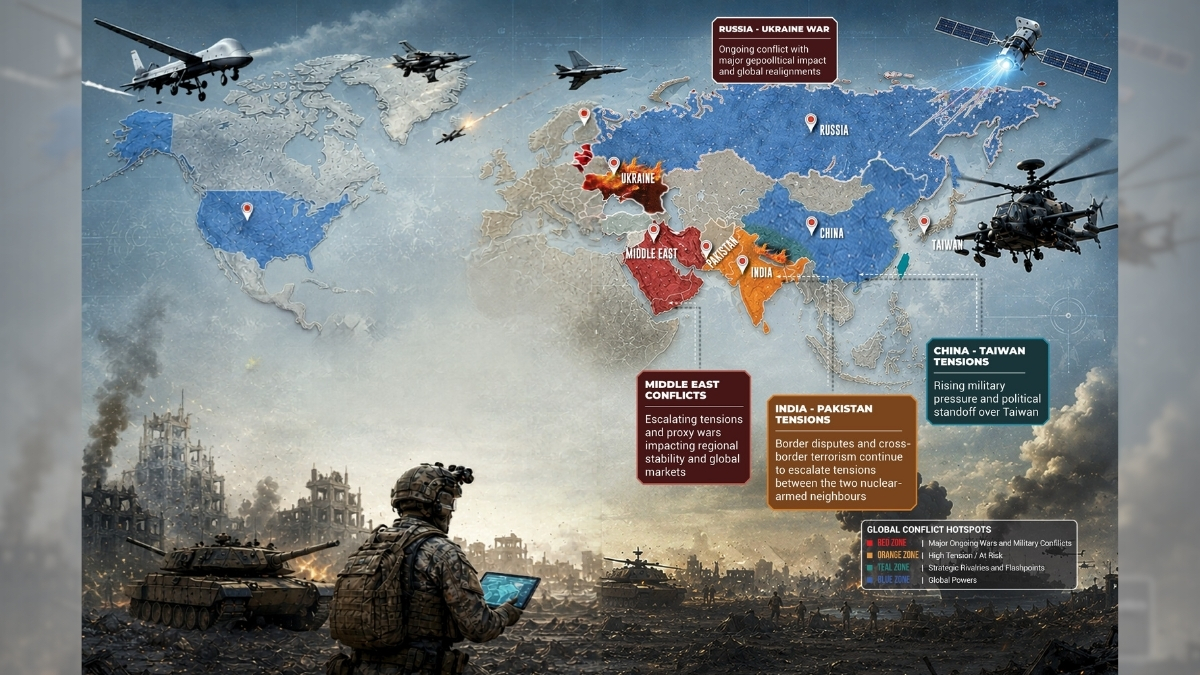
Global hotspots are fuelling a new wave of military competition and defence spending (Infographics: Media India Group/Hitesh Mehta)
A lot has changed across in the world of defence and geopolitics since June 21, 2024 when curtains were drawn on the 2024 edition of Eurosatory, one of the most important global defence industry exhibitions that is held every alternate year in Paris.
A series of conflicts around the world have put forth huge challenges for the global defence forces and the related industries as their collective conventional wisdom has been cast aside brutally and things that were unexpected and even unimaginable just two years ago have happened, sending military strategists rushing back to the drawing board, leading to heated arguments in war-rooms across the globe.
The prolonged conflict between Russia and Ukraine, which is now in its fourth year has shown how a smaller army and smaller nation can hold its own against what is one of the most powerful armies across the world, with innovation, courage and of course a lot of material and financial assistance from allies.
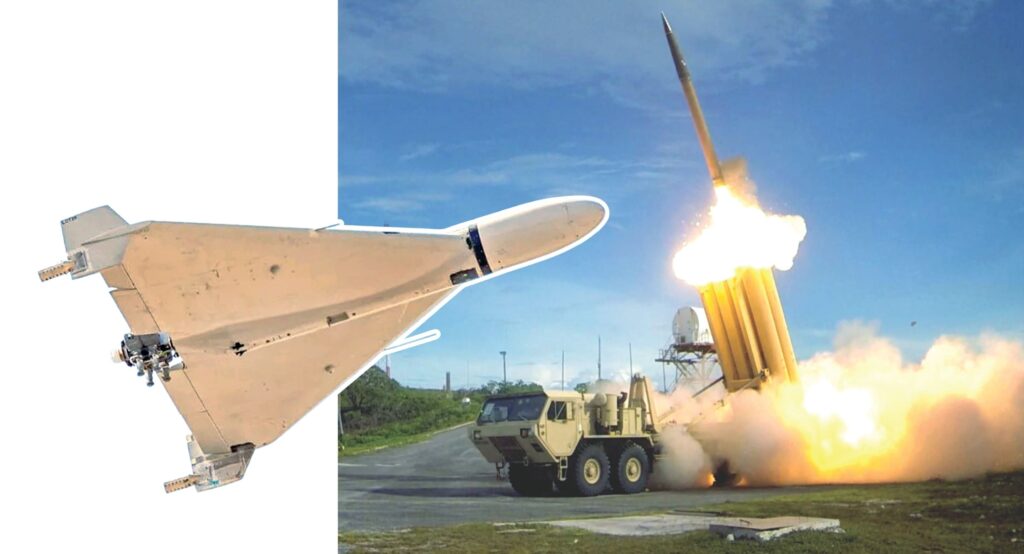
Low-cost Iranian Shahed kamikaze drones were deployed to overwhelm multi-billion-dollar US THAAD air defence systems
While Ukraine being able to continue fighting Russia even at this stage of the war is surprising, a bigger surprise has emerged from an unrelated conflict that broke out earlier this year, on February 28, when the United States and Israel joined hands to launch an unprovoked attack on Iran.
On paper, either one of the two nations, the US or Israel, is enough to prevail on Iran, which is by no means a pushover militarily, and when the two came togegther, it was difficult to see how Iran could withstand the torrent of smart bombs and guided missiles by two of the most advanced armies of the world. And in the firstfew days, it did look like the US-Israel alliance was winning the war, having killed several senior Iranian leaders, including Ayatollah Khamenei, the spiritual leader of not just Iranians but the entire Shiite community worldwide.
But within a few days, the Iranian forces seemed to have gathered themselves and then began counter-attacking aggressively, not just hitting targets in Israel but alsothe US military bases in the region, notably in the six member nations of the Gulf Cooperation Council (GCC), including Bahrain, Kuwait, Saudi Arabia, Qatar and the United Arab Emirates. Thousands of Iranian missiles and drones pummelled these nations everyday, causing widespread damage and mayhem. Iran seems to have singled out Qatar and the UAE for the harshest punishment, by keeping the attacks coming.
Also Read: With energy crisis, India real loser in US-Israel attack on Iran
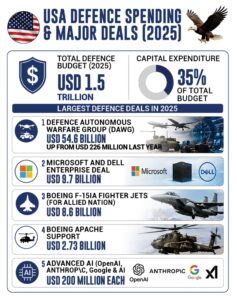
The US is ramping up defence spending, with drones, AI and advanced military systems driving major contracts
Within days, the US was reported to have lost dozens of aircraft and other high value defence equipment including the world’s most advanced land-based radars. There were also reports of deaths of 15 US military persons and hundreds injured. By June 3, the US material losses were reported to be in tens of billions of dollars and the war had left over 543 US military personnel injured. Over 20 US military sites had been hit by Iranian drone and missile salvos, resulting in billions of dollars in equipment damage, besides loss of at least 42 aircraft and drones, including 11 MQ-9 Reaper drones.
The strong fightback by Iran caught both, the US and Israel, offguard and after almost six weeks of incessant bombing of Iran, by mid-April, Trump halted the attacks almost as suddenly as they had begun, saying that he had done so as Iran was seeking a settlement and also at the request of his ‘dear friend’ Pakistan’s Military Chief Field Marshal Asim Munir, Chief of Pakistan Army and the most powerful person in Pakistan, who had been mediating before the two nations.
Drones: Dramatic game changers
Though Iran’s air power, in the traditional sense, was completely overwhelmed by the US-Israel axis, it was its use of ‘non-conventional’ air power that has left the two countries exasperated. Launching thousands of its mass-produced cheap drones, notably Shahed drones, Iran overwhelmed even the most advanced and much-vaunted air defence systems installed by Israel and by the US, across the member countries of the Gulf Cooperation Council (GCC), notably in Kuwait, Bahrain, the United Arab Emirates, Qatar and Saudi Arabia.
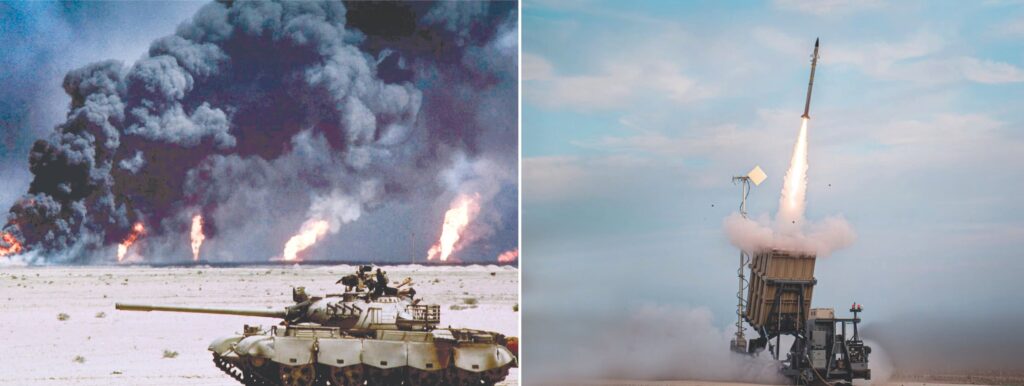
Modern conflicts are redefining warfare through technology, precision strikes and advanced defence systems
Before the war began, the US and Israel were certain that Iran would fail to penetrate their multi-billion air defence systems such as Patriot, THAAD and Israeli Iron Dome. However, employing mass saturation tactics, by launching dense swarms of low-cost Shahed-series kamikaze drones, alongside doznes of ballistic missiles, Iran forced Israel and the GCC nations to exhaust their highly expensive interceptors, which were limited in numbers.
So rapidly were the air defences depleted that the US production could not keep pace with the rising demand across the region and now the entire GCC area and Israel have to wait months, if not years, to replenish their stocks for any future conflict.
Iranian military strategists had clearly outsmarted their counterparts in the Pentagon and Israeli Defence Forces as they applied a three-pronged strategy to counter the attack the US-Israel forces.
The first logic used by Iranians is basic economics of war. A single THAAD or Terminal High Altitude Area Defense (THAAD) battery costs close to USD 1.2 billion and interceptor missiles used by it cost close to USD 15 million each. Moreover, to manufacture these complex systems, the US defence contractors take months for each battery. In contrast, Shahed drones are mass-produced, in numbers of thousands every month, and cost as low as USD 20,000 each.
Also Read: Drone Warfare: Redefining military conflicts with precision and swarm tactics
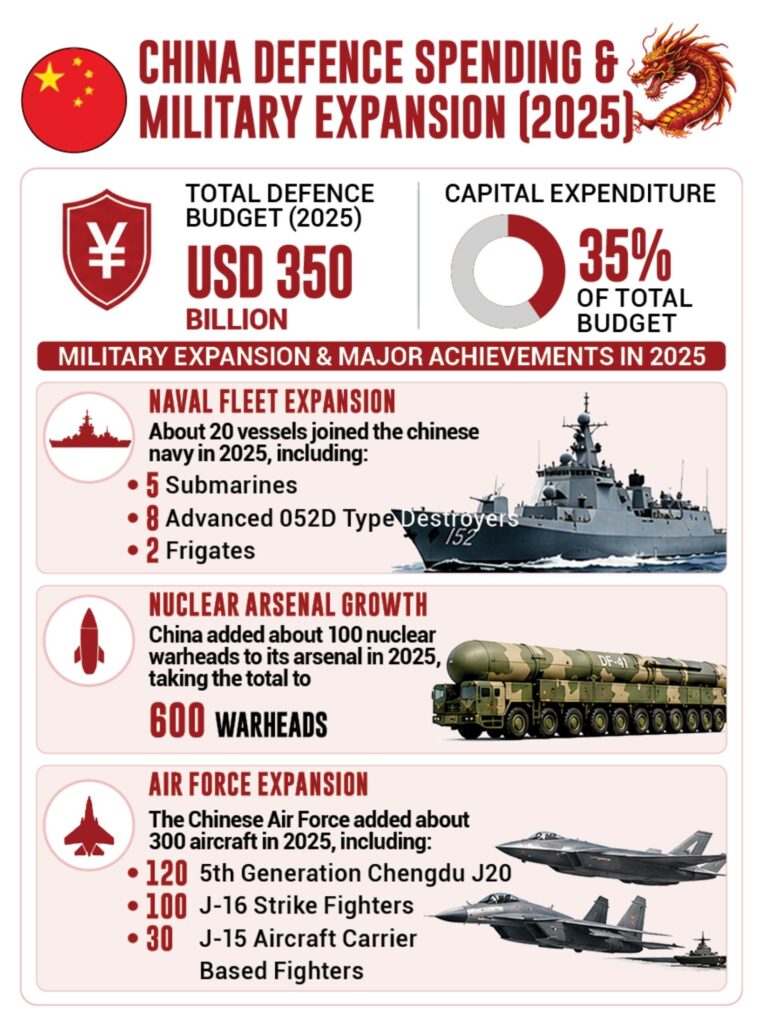
China’s military expansion is gathering pace, driven by investments in naval, air and nuclear capabilities
Moreover, Iran deployed swarms of hundreds of drones, along with dozens of missiles. This ensured that even if the defence systems successfully intercepted the vast majority, the sheer volume eventually overwhelmed radar tracking and magazine capacities, allowing some drones and missiles to reach their targets.
The third prong of Iranian strategy was to launch the drones as a diversion to attract the attention of air defence systems, while simultaneously launching ballistic missiles to ensure that the missiles penetrate the air defences and reach their targets. Moreover, the drones were flown at low altitudes and utilised varying approach vectors to minimise early detection and maximise the damage inflicted on critical infrastructure. Thus, Iran was able to economically and militarily overwhelm its adversaries, despite their superior capabilities, at least on paper.
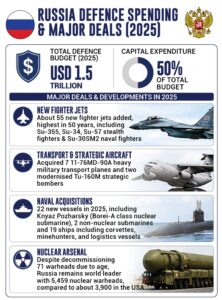
Heavy defence spending remains central to Russia’s strategy as it modernises key military assets
Drones have made a big difference not just in the conflict in the Gulf, but they have also allowed another smaller power to sustain a conflict against a much stronger rival. When Russian forces invaded Ukraine in February 2022, few expected that the battle would be continuing four years later. In addition to the billions of dollars in aid and all the latest glitzy military equipment donated by the United States and European Union countries, Ukraine has been able to rapidly develop and deploy a variety of drones that have allowed it to inflict some serious damageon Russian forces, dramatically slowing down their advance and managing to continue to fight them forcefully even four years later.
What is surprising is the way drone manufacturing has become a household industry across Ukraine where a number of volunteers have joined hands together to set up ‘garage workshops’ for manufacturing inexpensive drones that have managed to extract a heavy price from the adversary.
Seeing the efficiency of the drones and the low costs associated with using thousands of them, Russia has hiked up not only its own drone production, but also obtained Shahed drones from Iran and is also reported to have received drones from China and North Korea.
Drone warfare in Operation Sindoor
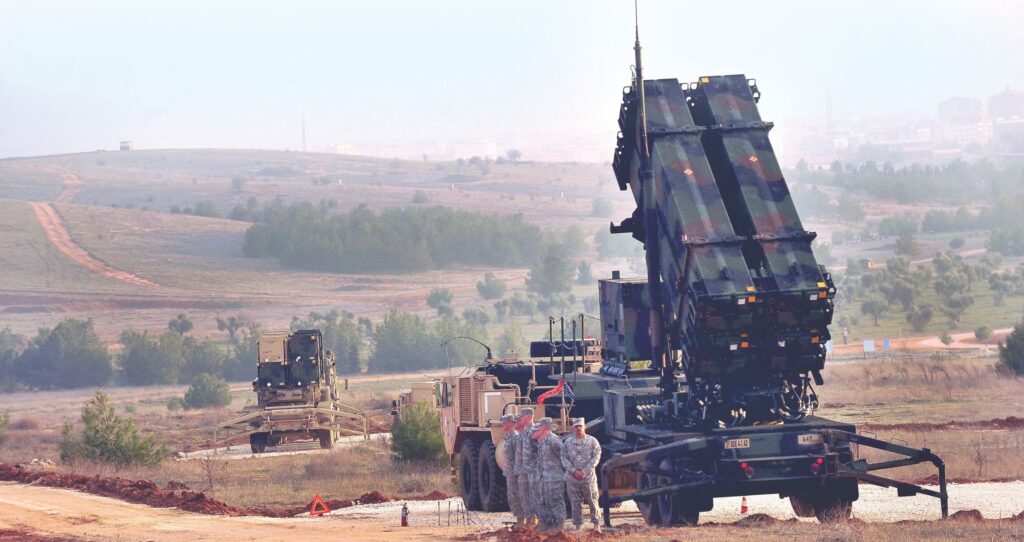
The US Patriot air defence system highlights the challenges of defending against mass drone and missile attacks
The Indian military strategists certainly have been following the developments in both the RussiaUkraine conflict as well as the nowon, now-off battle between US-Israel and Iran, to see the increasing role of drones in modern wafare and how these tiny objects can punch far above their weight.
Drones were also used in large numbers during Operation Sindoor, the four-day conflict between India and Pakistan last year, that broke out after 26 tourists were killed in Jammu and Kashmir, by armed terrorists allegedly sponsored by Pakistan.
The conflict saw a vast usage of drones as well as aircraft and missiles, with practically no action involving the ground-based troops of both the countries.
It also exposed a few holes in the Indian defence system as quite a few Pakistani drones managed to cross the border and hit some border villages before they could be downed. India, of course, hit back strongly with its BrahMos missiles as well as attacks by the Indian Air Force planes that soon gained complete air superiority over Pakistan Air Force. once the government gave the IAF a free hand to counter Pakistani attacks.
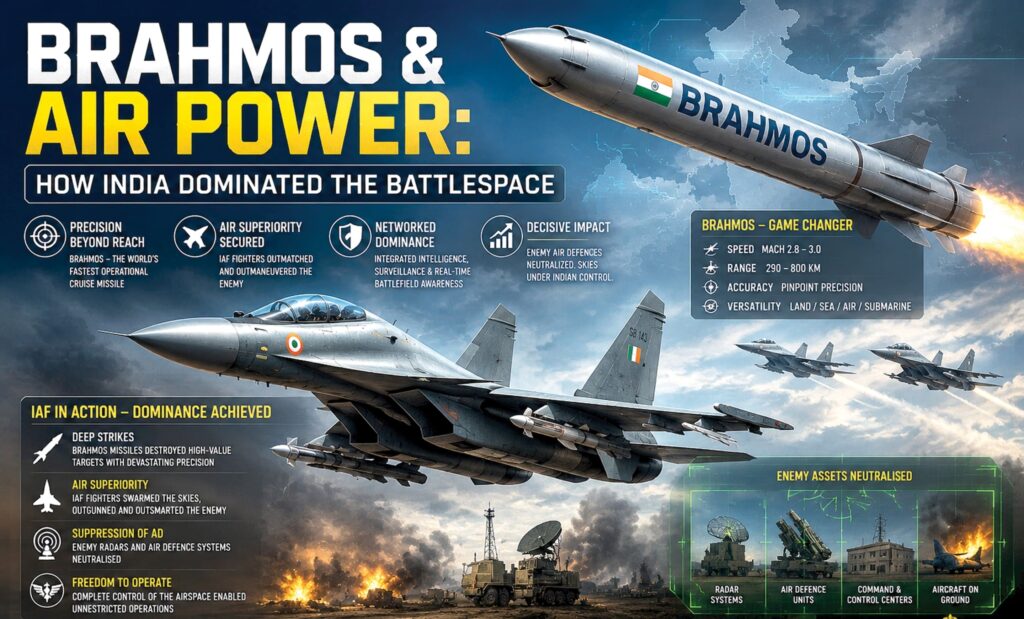
BrahMos missile, an Indo-Russian collaboration, has proven to be highly successful
As the dust settled from the conflict, the Indian defence forces as well as the government realised the urgency of plugging the holes that were exposed during the conflict. In the months following the battle, the Defence Ministry expedited several programmes for acquisition of weapon systems whose critical need had long been felt, but which were advancing at a snail’s pace as has been the case with all major defence acquisition programmes in India, be it domestic or overseas.
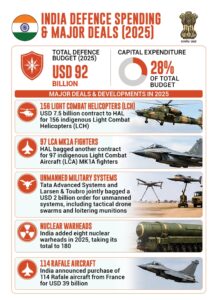
India accelerates military modernisation with record defence investments
Within months, a flurry of arms acquisition plans were finalised by the Indian government. These included purchase of 114 Multi-Role Fighter Aircraft (MRFA) Rafales to strengthen the combat capability of the IAF, for which the Indian government has already issued a Letter of Request to the French government.
The Indian government has also expedited the discussions on acquisition of 60 Medium Transport Aircraft (MTA) in order to modernise tactical airlift capabilities. In addition, it has also confirmed continued production and induction of Tejas Mk1A fighters and 156 Prachand light combat helicopters from HAL, the country’s largest defence manufacturer.
Another contract that has been expedited is the USD 8 billion contract with Germany for building six advanced diesel-electric attack submarines aimed at enhancing under-sea warfare, with a high degree of localised manufacturing at Mazagaon Docks Shipbuilders (MDL) in Mumbai.
In addition, the government has also speeded up the process for acquisition of Surface-to-Air Vertical Launch – Shtil missiles for the Navy to boost air defence capabilities as well as procurement of 48 torpedoes from Italy for Scorpène-class submarines made at MDSL facility in Mumbai.
Good times for global defence industry
While the way the recent conflicts have gone may have exasperated the Generals and governments, defence production companies have been ecstatic as they have never had it so good, with most of the big nations turning up their defence spending in a serious manner and placing dozens of big ticket orders. As a result, the total order book of the global defence industry stands today close to USD 747 billion, a record figure that has been driven by rising geopolitical tensions and multi-year government procurement programmes. The global order book has risen by over 25 pc just in the last two years. Leading the order book is RTX Corporation, formerly Raytheon, an American aerospace and defence giant, which has an order backlog of USD 271 billion, followed by fellow American giant Lockheed Martin with USD 160 billion in orders, including large portfolios for the F-35 fighter programme, space, and missile defense systems.
The ballooning order books have been wildly cheered by the stockmarkets, sending the valuations of defence companies across the world ballooning. From June 1, 2023 to June 1 this year, several large cap defence stocks have risen in values by anywhere between 50-80 pc.
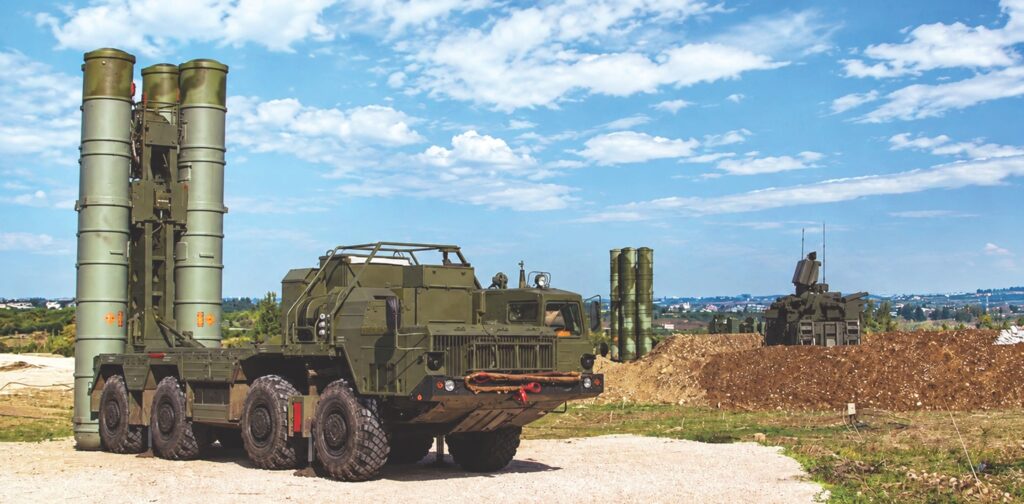
Russia’s S-400 remains a cornerstone of Indian air defence strategy
With the largest order book in hand, it is no surprise that RTX Corporation also tops the world and is the most valuable defence company globally with a market cap of USD 242 billion, a growth of 130 pc from the USD 105 billion registered on June 1, 2023. European aircraft manufacturer Airbus has seen a 105 pc rise in its market cap in the last three years, standing now at USD 198 billion, up from USD 89 billion three years ago. The archrival of Airbus, American aircraft manufacturer Boeing stands third in the list with a valuation of USD 171 billion, a growth of 57 pc in three years, followed by French aircraft engine manufacturer Safran, whose market cap now stands at USD 150 billion, up from USD 63 billion, a growth of 138 pc.
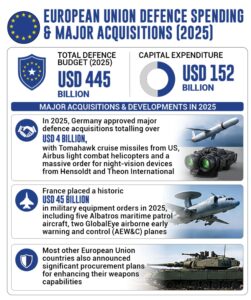
European Union is boosting defence spending and military procurement to strengthen security amid evolving global threats
The phenonmenon can be observed in India, too, where various defence company stocks have hit sky high levels, boosted by record high order books.
The total defence order book in India now stands close to USD 48 billion, an overwhelming share of which is controlled by the state-owned Defence Public Sector Undertakings (DPSUs), reflecting their dominant presence in Indian defence manufacturing sector. Leading the Indian order book is aircraft manufacturer, Hindustan Aeronautics Limited (HAL), which has an order book of INR 2.6 trillion close to USD 28 billion or over 50 pc of the total orders that Indian defence manufacturing sector has. This massive backlog, covering orders for deliveries up to 10 years from now, is primarily driven by major contracts for LCA MK1A fighter jets, helicopters, and aeroengines. Boasting the second largest order book is another DPSU, Bharat Electronics Limited (BEL), which has orders worth INR 740 billion, or about USD 8 billion, mainly due to large-scale production demandsfor radar systems, missile systems such as Quick Reaction Surface-to-Air Missiles and communication equipment.
Taking the third spot is yet another DPSU, Mazagon Dock Shipbuilders Limited (MDL) that has an order book of INR 400 billion or USD 4.2 billion mainly for submarine manufacturing programmes, including the recent deal for German submarines.
In terms of rise in market capitalisation, BEL has seen a three-fold rise in its value, from INR 820 billion (then USD 10 billion) on June 1, 2023 which now sits at INR 2.98 trillion (USD 31.4 billion). HAL, which enjoyed the market leadership on June 1, 2023, with a market capitalisation of INR 1050 billion (then USD 12.8 bilion) has been through a rather rough patch due to problems with its Tejas series of fighter aircraft, which has seen it slide to second spot, just behind BEL with a market cap of INR 2.82 trillion (USD 29.6 billion). The submarine maker, MDL, has surfaced rapidly to see its market capitalisation jump six fold from INR 160 billion on June 1, 2023 (then USD 1.94 billion) to INR 978 billion on June 1, 2026 (USD 12 billion).
Also Read: On Day 7 of US-Iran war, Indian diaspora remains stranded in Iran
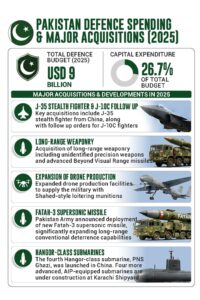
Pakistan strengthens its military with new fighters, missiles and naval assets
Beyond the star performers in the public sector, the defence industry broadly has seen a serious revaluation of its stocks, with the sectoral market capitalisation jumping six fold in the past three years, rising from INR 2 trillion to over INR 12 trillion now.
The Way Ahead
Beyond the public sector, which has spear-headed the defence production in the country for over seven decades now, the past few years have also seen the rise a number of private sector companies in the country, with the government handing them lucrative contracts on a platter, with the sole condition of finding a renowned global manufacturer as a partner. And on occasions, the government has also gotten into the business of matchmaking between its preferred Indian business tycoons and select foreign counterparts.
However, not all such marriages are made in heaven and some of them end up in rather messy divorces rapidly as was seen in the meltdown of the joint venture between Anil Ambani and Dassault for the lucrative offsets part of the Rafale deal in 2015. Prime Minister Narendra Modi himself announced the partnership in Paris when he announced the purchase of 36 Rafale jets for about INR 600 billion.
A big chunk of the 50 pc offset commitment for this deal was set for Dassault Reliance Aerospace Limited (DRAL) which formed Dassault’s JV with Reliance Defence. However, Reliance Defence was not all geared up for such a massive undertaking and with Ambani himself caught up in a web of bankruptcies, Dassault dissolved DRAL two years ago.
The new entrants to defence industry, and especially the government, would do well to remember that without proper investments, research and development and the suitable talent, the private sector can not hope to simply vaultz into the room and pick up deals, even if they are served on a platter. No amount of political patronage can buy the wherewithall needed to build stellar defence companies that can compete in the world.
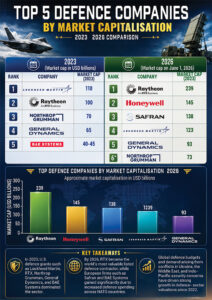
Rising geopolitical tensions are driving record growth in the market value of the world’s leading defence companies
And herein lies the other major weakness of the Indian private sector. It has been historically extremely stingy in investments, per se, and especially in research and development. Across all sectors, Indian private sector has spent less than 1 pc of its net sales on R&D, leaving the bulk of the spend on the shoulders of the government and public sector, which have accounted for about 66 pc of total R&D spend. In comparison, the private sector in developed economies accounts for as much as 80 pc of spending on R&D.
If India has to really see the emergence of a strong, independent and indigenous defence manufacturing industry in the private sector, the government must make it mandatory to spend at least 5 pc of all sales in R&D, if they want to receive handouts of lucrative deals from the government. Now the ball is firmly in the private sector’s court.
In the meanwhile, the government would do well not to sacrifice the public sector, which remains the mainstay of the defence manufacturing and ensure that deals are equitably distributed between the companies that have proven their mettle, even if with problems, rather than putting them all out for companies that would simply crumble or reap the benefits of zillion-dollar deals without going all the way. Only an equitable distribution of business, with strict conditions and monitoring of investments and R&D by private companies, can help make India even more self-reliant than it has been over the past many decades.