

Closure of the Strait of Hormuz after US-Israel strikes on Iran disrupts 20 pc of global oil and gas flows, driving a sharp global rise in energy prices
Sitting in the middle of the Persian Gulf and the Arabian Sea is a norrow body of water, the Strait of Hormuz, which is barely 21 nautical miles or 39 km wide at its narrowest point and serves as the maritime boundary between Iran and Oman.
Yet through this narrow corridor flows nearly 20 pc of the world’s oil and gas supply that presently meets nearly 80 pc of global energy need . Historically, whenever tensions have escalated in the Gulf, the thousands of oil tankers that cross the strait every year, hesitate to pass through these waters.
The consequences of blocked tankers ripple across the planet, causing a sharp spike in prices across the world, from transport costs in Asia to inflation in Europe and food prices in Africa.
Like in the past Gulf-conflicts starting from 1973, the current conflict involving Iran has once again reminded the world how fragile the global fossil-fuel system, raw material of global energy, really is.
But while in the previous oil shocks, there was hardly any option for the world to grin and bear the shocks as the prices zoomed to record highs, this time the crisis has come in an entirely different setting. For the first time, humanity has both the scientific consensus and the technological alternatives to break-free from this cycle of vulnerability caused by geo-politics deeply rooted in fossil fuel. This crisis has come at a time when a large resource of alternative and renewable energy is already in place and the world just needs that nudge to move towards adopting renewable energies in a bigger and broader manner. And this oil crisis could actually provide that trigger for the long-awaited transformation away from fossil fuel.
Also Read: India’s LPG shortage threatens small food businesses
Oil crisis existed before action on climate crisis
The global economy faced its first major oil shock in 1973–1974 when Arab oil embargo sent prices soaring and forced oil-importing countries to confront their dependence on Middle Eastern energy. The 1979–1980 crisis during the Iranian Revolution and Iran-Iraq war triggered another surge in prices and global recession. A decade later, the 1990–1991 Gulf War once again disrupted oil markets.
Those crises reshaped geopolitics with the ‘production limit’ games being played by members of the Organisation of Petroleum Exporting Countries (OPEC), the cartel of oil exporters, and the so-called ‘energy-policy frames’ around the globe . Countries , however, learned to create strategic petroleum reserves, improved energy efficiency, and diversified supply routes. But there was a crucial limitation: the world had no viable alternative energy system. What more , the oil industry, had proven to be a very effective and powerful weapon to manipulate the world.
Until late 1990s, both solar and wind energy were still considered to be experimental and fanciful technologies. Electric vehicles were decades away from commercial viability and climate change was on the fringes of the public discourse. The Intergovernmental Panel on Climate Change (IPCC) would not be established until 1988, and the UN Framework Convention on Climate Change (UNFCCC) would only emerge in 1992.
The scientific warnings about the dangers of fossil-fuel dependence had not yet fully entered the global policy arena. Consequntly, the past oil crises ultimately reinforced the fossil-fuel system rather than transforming it. And instead of trying to wean itself away from the highly-addictive fossil fuels, the world went deeper in its dependence on oil and other fossil fuels.
New Energy Realm of 21st Century
But fortunately, the situation is entirely different this time. Though the renewable energies have been known to humankind for millennia, the advent of coal and oil had made humanity forget about them and almost wiped them off the face of the earth.
The recent interest in renewables was regenerated and driven primarily due to the ever increasing frequency and intensity of the extreme weather events all over the world and its undeniable link to the climate change. Added to that was the need to reduce dependency on imported fossil fuels which resulted in opening of the gates for development and deployment of solar and wind energy, which led to a significantly lower costs for solar and wind technologies.
In parallel, the global convening power of the United Nations was seen in action. Starting from the 1972 United Nations Conference on the Human Environment in Stockholm followed by 1992 Rio Earth Summit, or the United Nations Conference for Environment and Development, and then 1997 Kyoto Protocol under United Nations Framework Convention on Climate Change and the 2015 Paris Climate Agreement. The trigger, however, was the necessity to find the solution to repeated oil crises and the parallel push by UN’s annual climate conferences. The development of and funding mechanisms like Global Environment Facility and Green Climate Fund pushed the agenda in small and developing countries. The oil crisis and recognition of limited stock of fossil fuel also catalysed the technology development of renewable energy .
The IPCC’s scientific assessments, developed by thousands of scientists worldwide, made it clear that continued reliance on fossil fuels threatens the stability of the Earth’s climate system. The recognition of this risk culminated in the Paris Agreement in 2015 and, more recently, the historic decision at COP28 in 2023 in Dubai where governments agreed to transition away from fossil fuels in energy systems. Unfortunately, in the political negotiations that followed in COP29 and COP30, that momentum has begun to weaken. Some countries have attempted to soften the language of fossil-fuel phase-down in subsequent climate discussions. But here comes good news from narrow strait. The latest bottleneck in the Strait of Hormuz may possibly open floodgates to move away from oil! Countries can seize this opportunity to speed and scale their independence from oil.
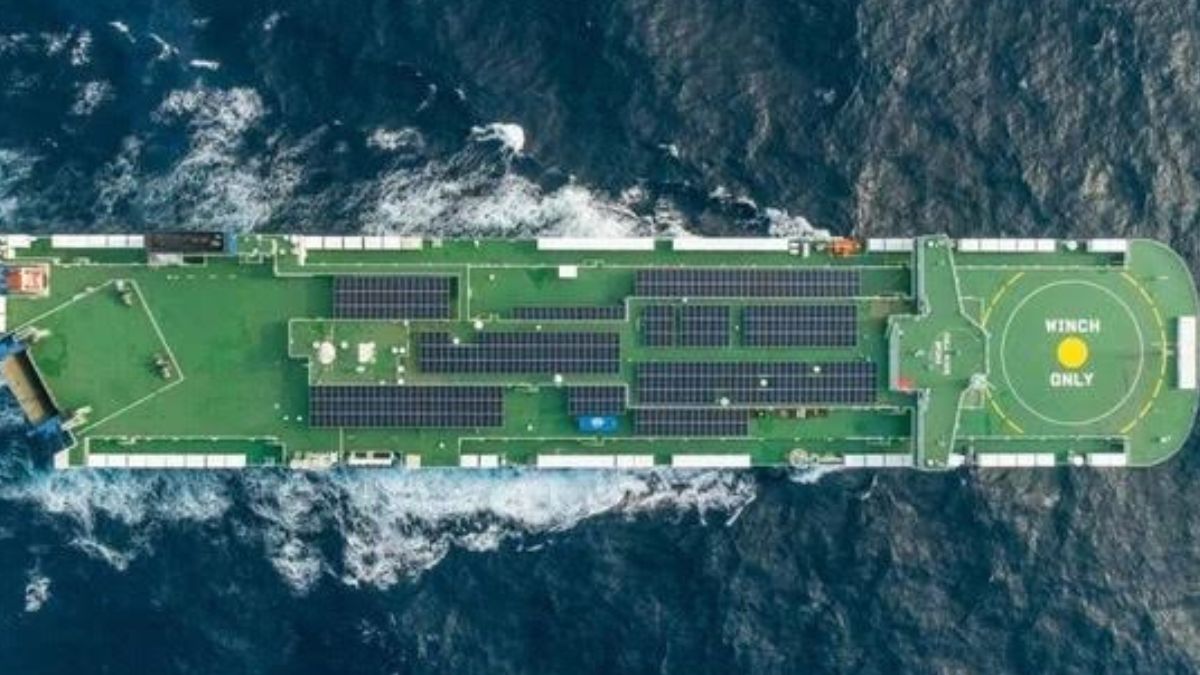
Oil tanker with solar panels
The stage is set. The latest reports of the International Energy Agency (IEA) reveal that global renewable-energy capacity is expanding at an unprecedented pace. The agency reported that the world is set to add over 5,500 GW of new capacity between 2024 and 2030, nearly triple the growth seen from 2017 to 2023. In 2024, additions surged by roughly 25 pc to nearly 700 GW, with solar PV accounting for over 75 pc of new, global, renewable capacity additions. Solar and wind are now the fastest-growing sources of electricity in history.
In many parts of the world, solar power has become the cheapest source of new electricity ever recorded. Over the past decade, the cost of solar photovoltaic technology has fallen by as much as 90 pc, while wind power costs have dropped dramatically as well. Renewables are not just a climate solution, they are also becoming the most economically rational choice.
Also Read: With energy crisis, India real loser in US-Israel attack on Iran
Asia : Mine of Energy Transformation
Perhaps the most powerful evidence of this transformation has emerged from Asia whose countries realised that they are worst affected by oil-crisis. China is the world’s largest importer of crude oil. India, world’s third-largest oil consumer, imports over 85 pc of its crude oil requirements.
Both countries are leaders in solar and wind deployment, installing renewable capacity at a pace that exceeds the combined additions of many advanced economies and becoming the fastest-growing renewable markets, with ambitious targets for solar energy, green hydrogen, and electric mobility.
These developments are reshaping the global energy landscape. For countries that import large quantities of oil through the Strait of Hormuz, renewable energy offers something fossil fuels never could: strategic independence. Sunlight cannot be blockaded as there is no Strait of Hormuz in the space. Wind cannot be embargoed as there are no geo-political controls on wind patterns. Asia is able to get these lessons, thanks to the wider opportunity provided by the closure of the narrow sea-lane of 21 km.
The Climate Action Has Changed the Equation
Meanwhile, fossil fuels remain subject to geopolitical instability and volatile prices. In other words, the global energy equation is shifting. Another crucial difference between today’s crisis and earlier oil shocks is not only the global awareness of climate change but unstoppable actions on climate crises, particularly in Asia. No act of exit of any country from UN climate deal can now stop the renewables, even if it is the richest country in the world. Renewables have renewed the interest of the countries to shred the ‘Hormuz Bottleneck’.
Every tanker that hesitates to cross the Strait of Hormuz highlights the same, simple fact. The global economy still depends on a fragile network of pipelines and maritime chokepoints vulnerable to geopolitical conflict. A single narrow passage can disrupt energy supplies affecting billions of people.
Global energy system should not be dependent on such vulnerabilities and hence the world has no option but to turn to renewable energy in a bigger way since neither sun, nor wind or water are under the control of a cartel of countries and neither can they be choked since by definition these energy forms are inherently decentralised. Solar panels on rooftops, wind farms across plains and coastlines, tapping energy from rivers and tides and emerging green-hydrogen systems can create a distributed energy architecture far less exposed to geopolitical shocks. In that sense, the energy transition is not just about reducing emissions. It is about building a more stable world.
Also read: On Day 7 of US-Iran war, Indian diaspora remains stranded in Iran
Crisis as Catalyst
Conflict destroys lives, ecosystems, and infrastructure, while military operations themselves generate significant emissions. But history also shows that crises often accelerate transformations that were already underway.
The Covid-19 pandemic is a fitting example. It revealed both the fragility and the resilience of global systems. It forced societies to rethink public health, supply chains, and international cooperation. The disruption in the Strait of Hormuz could play a similar role for the global energy transition aimed at sustainable solution: from Covid-19 to Vivid-26!
The proverb says that ‘adversity and necessity are the mothers of invention and transformation. Today’s turmoil may again force humanity to transform faster, invent smarter, and rethink clearer about the foundations of global energy system.
Opportunity before global community
For decades, climate scientists have warned that the continued burning of fossil fuels poses a grave risk to humanity. Now geopolitics is reinforcing the same message. The question for global leaders is whether they will treat this crisis merely as another temporary oil shock, or recognise it as the trigger to accelerate the transformation that is already happening.
Renewable energy is no longer a distant aspiration. It is increasingly the cheapest, safest, and most secure energy option available. The Strait of Hormuz may be shaking the global economy today. But it may also be opening a window of opportunity.
If the world chooses wisely, this crisis could mark the moment when humanity finally began to move decisively beyond the fossil-fuel era.
(Rajendra Shende is a former Director UNEP, Founder Director Green TERRE Foundation, coordinating lead author, IPCC that won Nobel peace prize, Prime Mover SCCN, IIT Alumnus. The views expressed here do not necessarily reflect those of Media India Group.)
